

Table of Contents
Last Tuesday, right after recess, Maya came back inside with her shoulders up near her ears and her eyes shiny with tears. She had lost a game of tag, and the walk back to class had not given her enough time to shake it off. She did not yell or throw anything. She just stood by the door, breathing fast, unsure where to put all that big feeling. I pointed toward the quiet corner by the bookshelf and asked if she wanted a minute there. She nodded, picked up the squishy ball, and sat on the beanbag. Five minutes later she was back at her desk, calm enough to open her math book.
That is really all a calm down corner needs to do. It is not a punishment spot, and it is not a reward either. It is a small, safe place where a child can slow down, sort out a feeling, and come back to learning when they are ready. Some teachers build theirs with a reading tent and a basket of fidgets. Others start with one rug, one pillow, and a jar of crayons. Both versions work, because the corner works when it feels kind and predictable, not when it looks perfect.
The ideas below are meant to be mixed and matched. You do not need all twenty five. Pick the ones that fit your room, your budget, and your students, and add new ones slowly as you see what kids actually reach for. Watch which tools get used and let the corner change with your class.
Soft Seats and Cozy Spots
A calm down corner starts with a place to sit that feels different from a desk chair. Soft textures, low seating, and a little bit of enclosure help a busy brain settle. Keep this area small and tidy, because a crowded corner can feel just as overwhelming as a noisy classroom.
1. Beanbag Chair
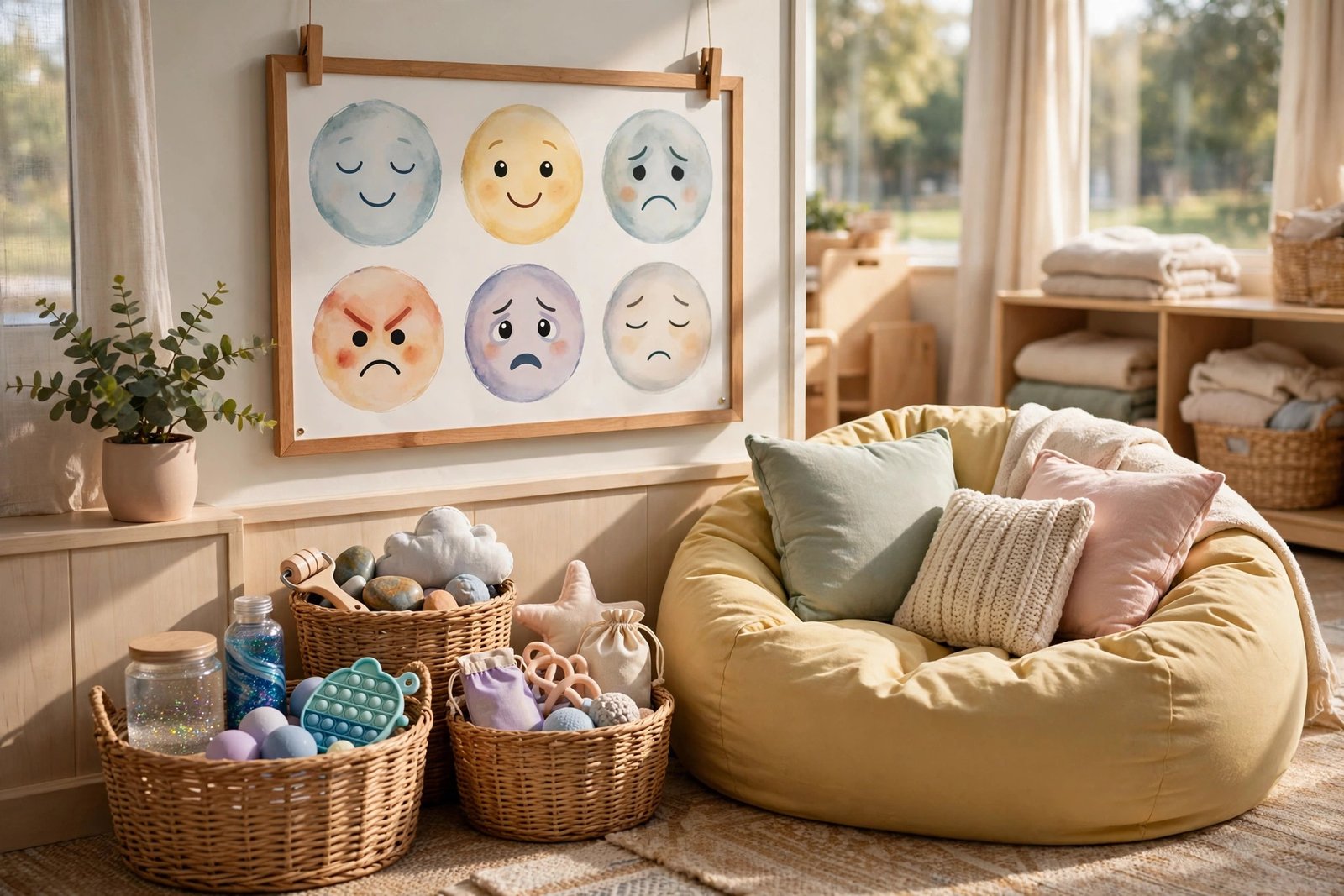
A beanbag chair gives a child a soft spot to sink into, and that gentle pressure can feel very settling. Place one beanbag in the corner with a small pillow tucked beside it. Teach students to sit, not flop or jump, so the chair lasts through the year. A beanbag chair works well for kids who need to feel held and grounded after a hard moment. Wipe it down once a week.
2. Reading Tent or Canopy
A small pop-up tent or a fabric canopy draped over a corner frame creates a cozy hideaway. Hang a soft blanket inside and add one pillow so the space feels snug but not closed off. Cut a wide opening so you can still see the child and they can still see you. A reading tent suits students who calm down best with a little privacy. Check the fabric now and then for tears or loose ties.
3. Floor Cushions and a Rug
A thick rug with two or three large floor cushions turns any bare corner into a welcoming spot. Choose cushions in calm colors and stack them neatly when the corner is not in use. Students can sit cross-legged, stretch out, or lean against the wall with a cushion behind their back. Floor cushions are cheap, easy to wash, and simple to replace.
4. Rocking Chair for Kids
A small, sturdy rocking chair gives restless kids a gentle motion to match their breathing. The steady back-and-forth rhythm helps some children slow down without needing to sit perfectly still. Place the chair on a rug so it does not slide. A rocking chair is a good fit for students who calm down through movement. Set a simple rule that only one child rocks at a time.
5. Weighted Lap Pad
A weighted lap pad rests across a child's legs and gives steady, gentle pressure while they sit. You can buy one or sew a simple version with fabric and rice, then cover it with a washable case. Let students try it for a few minutes and put it away if it feels too heavy. A weighted lap pad helps kids who like deep pressure and quiet sitting.
Hands-On Calming Tools
Some kids calm down by doing something with their hands. A small basket of quiet tools lets them squeeze, sort, build, or draw until their breathing slows. Keep each tool in its own small container so the corner stays tidy, and rotate the tools every few weeks so the basket feels fresh.
6. Squishy Stress Balls
Stress balls are the classic corner tool for a reason. A child can squeeze, roll, and press one while they sit, and the motion gives busy hands something safe to do. Keep three or four in a small bin, in different firmness levels, so students can pick the one that feels right. Squishy stress balls work well for kids who hold tension in their hands after a conflict. Replace any ball that starts to crack.
7. Sensory Bottles
A sensory bottle is a clear bottle filled with water, glitter, and a few small beads or sequins. When a child shakes it and watches the glitter settle, their eyes and breathing tend to slow down together. Make bottles with tight lids sealed with strong tape, and let students pick a color they like. Sensory bottles are wonderful for kids who need something visual to focus on.
8. Play Dough or Modeling Clay
A small tub of play dough lets a child roll, press, and shape something while their mind settles. Give them a flat tray to work on and a couple of simple cutters or rollers. Keep the dough in sealed containers so it stays soft, and set a rule that dough stays on the tray. Play dough suits students who calm down through steady, repetitive handwork.
9. Lacing Cards and Threading Beads
Lacing cards and big threading beads ask for slow, careful hand movements, which is exactly what a wound-up child needs. Punch holes around a stiff card shape, add a shoelace with a taped tip, and let students lace in and out. Large wooden beads on a thick cord work the same way. Lacing cards are a quiet, screen-free task that builds focus while the child settles.
10. Quiet Building Blocks
A small set of soft or wooden blocks lets a child build something simple without noise or mess. Stacking and balancing ask for just enough attention to pull a child's mind away from a worry. Keep the set small, maybe twelve to sixteen pieces, in a cloth bag on the shelf. Quiet building blocks fit students who like to create while they calm down.
11. Coloring Pages and Crayons
Coloring gives a child a calm, structured task with no right answer and no grade. Stock a folder with simple coloring pages, mandala-style patterns, and blank paper, plus a small box of crayons or colored pencils. Let students choose a page and color for as long as they need. Coloring pages work beautifully for kids who settle through quiet, focused art.
| Idea | Best For | Setup Time | Cost Level |
|---|---|---|---|
| Beanbag Chair | Kids who like deep pressure | A few minutes | Low to medium |
| Sensory Bottles | Visual focus and slow breathing | About an hour to make | Low |
| Play Dough | Repetitive handwork | A few minutes | Low |
| Breathing Ball | Visual learners learning breath control | A few minutes | Low |
| Stretch Cards | Tension after long sitting | About thirty minutes to make | Low |
| Coloring Pages | Quiet focused art | A few minutes | Low |
| Rocking Chair | Kids who calm through gentle motion | A few minutes | Medium |
| Lacing Cards | Careful slow handwork | About thirty minutes to make | Low |
Breathing and Body Calmers
Big feelings live in the body as much as in the mind. A racing heart, tight shoulders, and fast breathing all tell a child they are not okay yet. Practice these ideas with the whole class first, so that when a child visits the corner alone, the steps already feel familiar and safe.
12. Breathing Ball
A breathing ball, sometimes called a sphere that opens and closes like a flower, shows a child how slow breathing looks. The child opens the ball as they breathe in and closes it as they breathe out, matching their breath to the motion. A breathing ball helps visual learners who struggle with counted breathing alone.
13. Pinwheel Breathing
A simple pinwheel turns slow breathing into a game a child can see. The child breathes in through the nose, then blows out slowly to make the pinwheel spin gently, not wildly. Tape a short breathing guide next to it, something like breathe in, blow out slow. Pinwheel breathing is perfect for younger students who need a visible target for their breath.
14. Stretch Cards
Stretch cards show simple, gentle stretches a child can do in a small space. Draw or print cards with poses like reaching up tall, touching toes, or twisting gently side to side. A child picks two or three cards and moves through them slowly. Stretch cards suit kids who carry tension in their shoulders and backs after sitting all morning. Laminate the cards so they last.
15. Calm Down Yoga Poses Poster
A poster with four or five easy yoga poses gives the corner a quiet movement station. Choose simple poses like child pose, tree pose, and a seated twist, and show each one with a clear picture. A child can stand on the rug and try one pose at a time. A yoga poses poster works well for students who need to move their whole body to settle. Keep the poster at child eye level.
16. Counting Breaths with Fingers
Counting breaths on fingers needs no supplies at all, which makes it one of the most useful corner tools. A child holds up one hand, traces up one finger while breathing in, and traces down while breathing out, then moves to the next finger. Five slow breaths usually take about a minute. Counting breaths helps kids who feel overwhelmed by tools and choices and just need one simple thing to do.
17. Shake It Out Spot
Sometimes a child needs to move fast before they can slow down. A small marked spot on the rug, maybe a taped star or circle, gives them a place to shake their hands, stomp gently, and wiggle for thirty seconds. Then they sit down and take three slow breaths. A shake it out spot fits high-energy kids who cannot sit still right after recess or a disagreement.
Feelings and Quiet Thinking
Once the body starts to settle, a child still needs help naming what happened and deciding what to do next. These ideas give feelings words and give kids a gentle way to think through a problem. A few words, a picture, or a card is plenty, and the teacher can talk it through later if the child wants to share.
18. Feelings Chart
A feelings chart shows faces and words for common emotions like mad, sad, worried, frustrated, and calm. A child points to the face that matches how they feel, and that small act of naming often takes some power out of the feeling. Hang the chart at child height and add a small pointer or clothespin. A feelings chart helps students who say "I do not know" when asked how they feel.
19. Calm Down Choice Cards
Choice cards list a few corner options with a picture and a short label, like breathe, squeeze, draw, or sit quietly. A child who feels too upset to choose can just point to a card, which removes one hard decision from a hard moment. Keep four to six cards on a ring near the entrance to the corner. Calm down choice cards are great for younger students and for kids who freeze when upset.
20. Feelings Journal
A feelings journal is a small notebook where a child can draw or write what happened and how they feel. Give them sentence starters on the first page, like "I felt upset when" and "Next time I could". There is no grade and no required length, even one sentence counts. A feelings journal suits older students who process feelings better on paper than out loud. Keep the journals private in a small box.
I tried a feelings journal with my class last spring, and I will be honest, it started out rough. The first week, two students wrote one word and stopped, and one boy just scribbled. I almost pulled the journals out of the corner. Then I added sentence starters and a tiny box for drawing the feeling as a weather picture, stormy or sunny, and suddenly the same kids had something to say. One girl drew a rain cloud over a math worksheet, and that one picture told me more than a paragraph would have.
21. Problem Solving Steps Poster
A problem solving poster breaks a conflict into small, doable steps. The steps might read like this. What happened. How do I feel. What can I do next. Who can help me. A child reads through the steps slowly while sitting in the corner, then comes back ready to talk. A problem solving steps poster works well for students who get stuck replaying a disagreement in their heads.
Sound, Light, and Sensory Touches
The feel of a space matters almost as much as what is in it. Soft light, gentle sound, and a few sensory touches can turn a plain corner into a place a child actually wants to visit. Keep the sensory touches simple and low maintenance, so the corner stays a calm place for you too.
22. Soft Lamp or String Lights
Harsh overhead lights can make a wound-up child feel even more on edge. A small soft lamp or a strand of warm string lights gives the corner a gentler glow. Place the lamp on a low shelf where it cannot be knocked over, and use battery lights if outlets are limited. Soft lighting helps kids who feel overstimulated by a bright, busy room.
23. Noise Reducing Headphones
Classroom noise can keep a sensitive child wound up long after the upset moment has passed. A pair of noise reducing headphones, not earbuds, lets a child muffle the room while they sit and breathe. Keep them on a hook with a wipe nearby, and set a simple cleaning routine. Noise reducing headphones are a lifesaver for students who get overwhelmed by sound during group work or transitions.
24. Calm Music or Nature Sounds
A small speaker playing soft instrumental music or gentle nature sounds can set the mood for the whole corner. Keep the volume low, just loud enough for the child in the corner to hear, and choose tracks without sudden changes or lyrics. Calm music suits kids who settle faster with background sound than with silence.
25. Scented Cotton Balls in a Jar
A jar of cotton balls with a drop of a mild, pleasant scent gives the corner one more gentle sensory cue. Lavender or vanilla are common choices, but check school rules and student allergies first, and keep scents very light. A child can hold a cotton ball near their nose for a few slow breaths, then put it back. Scented cotton balls work for students who respond to smell as a calming cue.
Frequently Asked Questions
How long should a student stay in the calm down corner?
Most visits last about five to ten minutes, which is usually enough time for a child to slow down and feel ready to return. If a student needs longer, let them stay, but check in quietly after ten minutes to see how they are doing.
Is the calm down corner a punishment?
No, and it is important to say that out loud to your class more than once. A calm down corner is a tool, like a pencil or a reading rug, not a consequence. Children should be able to ask to visit it, and teachers can suggest it kindly when they see a child struggling. If students start to see it as a timeout spot, the corner loses its power, so keep the tone warm and the visits voluntary whenever possible.
What if a student refuses to leave the corner?
First, stay calm and give the child a little more time, since pushing often makes the feeling bigger. After a few extra minutes, kneel nearby and offer two choices, like returning to their desk or sitting with a buddy for the next task. If refusal keeps happening day after day, it may be a sign the child needs more support, so talk with your school counselor or support team.
How do I keep the corner from becoming a play area?
Clear rules and a little routine go a long way. Limit the corner to one student at a time, keep visits short, and teach the class which tools are for calming and which behaviors belong elsewhere. Rotate tools so the corner feels fresh but not like a toy shelf. Most classes learn the difference quickly when the teacher models it.
Do I need to spend a lot of money to start one?
Not at all. Many teachers start with a rug they already own, a pillow from home, a jar of crayons, and a handmade feelings chart. The ideas in this article range from nearly free to a modest one-time cost, and you can add one new tool a month as your budget allows. What matters most is a consistent spot, a kind routine, and tools kids actually use, not a fancy setup.
What if my classroom is too small for a corner?
Even a tiny space can work. A single chair beside a bookshelf, a small rug in front of a low shelf, or a cushion tucked near a window can serve as a calm down spot. Choose two or three portable tools in a basket that a child can carry to the spot and put away after. The feeling of a separate, quiet place matters more than the size of the space.
Final Thoughts
A calm down corner will not fix every hard day, and it is not meant to. Some days a child will sit there for two minutes and bounce back. Other days the same child will need a longer chat with you, or help from a counselor, or just a quiet lunch. That is normal, and it does not mean the corner failed. It means feelings are bigger than any one tool, and kids are still learning how to carry them.
Start with what you have. Pick a spot, add a soft seat, put out two or three tools, and teach your class how to use them with kindness. Over time, kids begin to notice their own feelings earlier, ask for a minute before things boil over, and come back to their desks a little steadier. Your corner does not need to impress anyone. It just needs to be there, warm and ready, when a child like Maya walks in needing a minute to land.
