
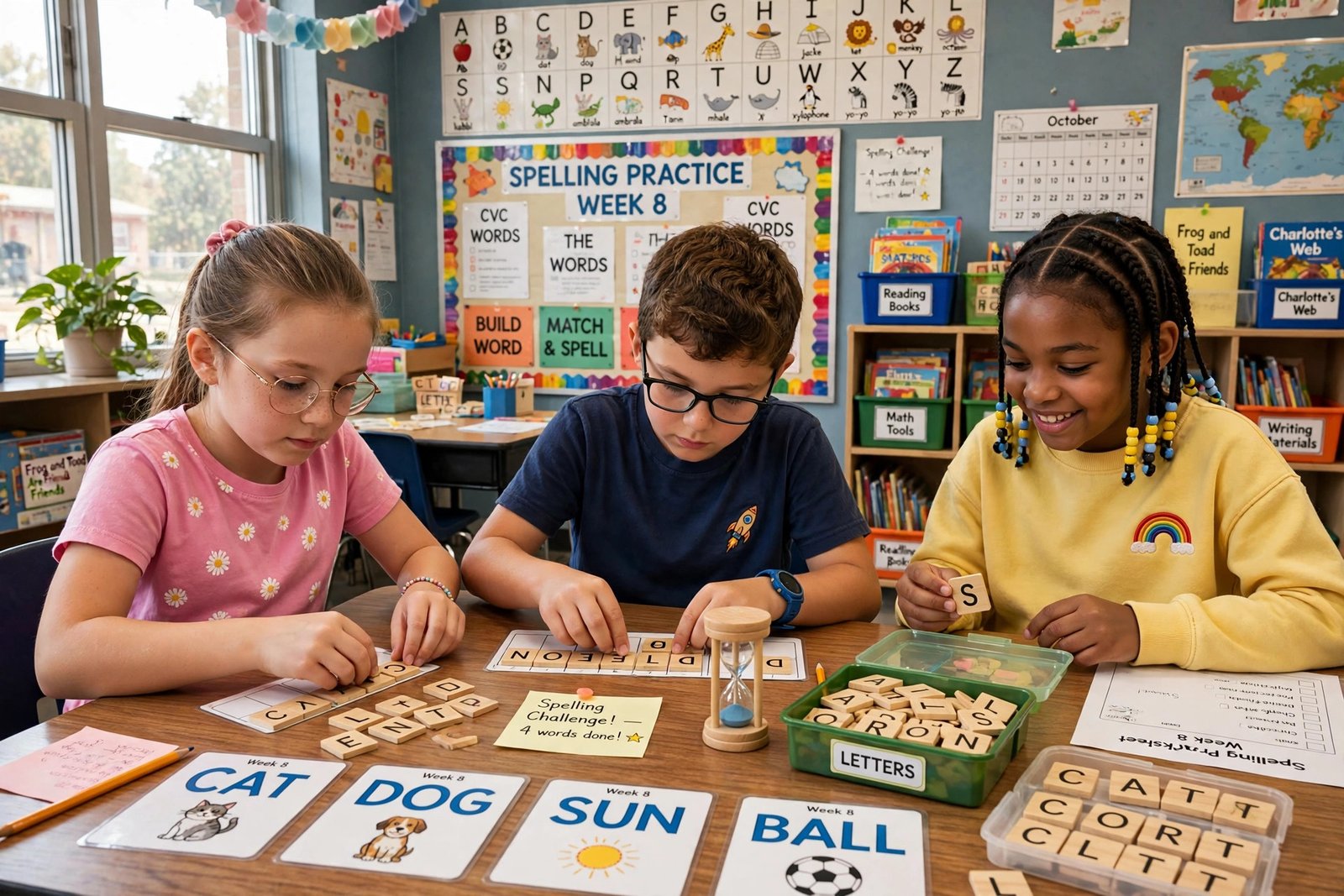

Good spelling practice in an elementary classroom looks like children using words in more than one way. They say a word out loud, they build it with their hands, they write it down, and they check it against a model. They get it wrong sometimes, and then they try again right away while the word is still fresh in their minds. Strong practice is short, active, and repeated across the week, not saved for one long session on Friday morning before a test.
The usual worksheet-only routine falls flat because it asks children to do only one thing with a word, which is copy it. Copying can look busy and quiet, but it does not force a child to think about letter order, sounds, or patterns. A student can fill a whole page and still misspell the same word on Friday, because the hand moved while the brain checked out. The activities below fix that problem by giving each word several jobs to do. Children move, talk, build, sort, and play with words, so the spelling sticks in a way that copying alone never manages.
Table of Contents
Movement Games
1. Jump and Spell
Write a spelling word on the board and read it aloud with the class. Children stand beside their desks and jump once for each letter while saying the letter names out loud. For a word like "friend," they jump six times and call out F, R, I, E, N, D. Jumping for each letter turns letter order into something the body remembers. For younger students, use short words with three or four letters. For older students, add a clap on each vowel to make them notice vowel placement.
2. Spelling Hopscotch
Draw a hopscotch grid on the playground or tape one to the classroom floor. Write one letter on each square, in the order of a spelling word, and let children hop through the squares while saying each letter. At the end of the grid, they say the whole word. This works best in small groups of four or five, with one child hopping while the others chant along. Rotate the word list every few rounds so every child gets a turn. For older students, use two grids side by side and race to finish first.
3. Letter Relay Race
Split the class into teams and give each team a set of letter cards. Call out a spelling word, and team members run one at a time to place the next letter in order on a table or whiteboard. The team that builds the word correctly first earns a point, but speed only counts if the spelling is right. Checking the word together at the end matters more than winning the race. Keep words short for first graders and use longer pattern words, like words with silent letters, for fourth and fifth graders.
4. Spell and Stretch
Assign a simple movement to each letter type. Children might touch their toes for a consonant and reach up high for a vowel. Call out a word slowly, and the class performs the movement for each letter in order. This is a calm movement game, which makes it a good fit for the last ten minutes of the day or for a rainy indoor recess. You need no materials at all, just a word list and enough floor space to stretch safely. Repeat tricky words twice so the pattern sinks in.
5. Word Hunt Walk
Hide word cards around the classroom or hallway before the lesson. Give each child or pair a target word to find, and let them walk quietly to search for it. When they find it, they read it aloud, spell it letter by letter, and bring it back to their desk. Hide the cards at different heights and in spots that take a little searching, but keep the hunt short so the focus stays on spelling. For older students, hide only word parts, like prefixes or suffixes, and ask them to find the parts that build their assigned word.
Writing and Word Building Games
6. Rainbow Writing
Give each child a spelling word list and three or four crayons or colored pencils in different colors. They write each word three times, using a new color each time, and they trace over the letters slowly instead of rushing. The color change forces them to look at the word again instead of copying on autopilot. Tracing slowly in a new color helps children notice tricky letter pairs, like "ie" or "ea." For younger students, limit the list to five words. For older students, ask them to underline the hardest part of each word in a fourth color.
7. Build It With Blocks
Hand out letter tiles, magnetic letters, or small building blocks with letters written on tape. Children build each spelling word on their desk, read it back, mix the letters up, and build it again from memory. Building by hand slows the process down in a good way, because a child has to pick each letter on purpose. Keep a word card nearby for the first build, then hide it for the second try. This activity works well in pairs, where one child builds and the other checks the spelling against the card.
8. Word Family Sort
Write a set of spelling words on cards and mix in a few extra words that do not belong. Children sort the cards into word families, such as words ending in "ight" or words starting with "bl." Sorting pushes children to compare words and notice shared patterns instead of memorizing each word alone. Sorting by pattern is especially helpful for students who struggle, because a pattern gives them a rule to lean on. Use picture cards for the youngest learners, and add a challenge column for words that break the pattern for older students.
9. Mystery Word Drawing
Read a spelling word aloud and ask children to draw a quick picture of what the word means, then write the word under the picture. A child might draw a bright sun for "sunny" or a tall ladder for "climb." The drawing connects meaning to spelling, which helps children remember words that do not follow a simple sound pattern. Keep drawings fast, about one minute each, so the lesson stays focused on words. For older students, ask them to draw the word used in a short phrase, which adds meaning without adding much time.
10. Erase and Rewrite
Write spelling words on small whiteboards or laminated cards. Children read a word, erase one letter, and rewrite the word from memory with the missing letter back in place. Then they erase two letters and try again. This gradual removal builds memory step by step, and children enjoy the small challenge of each round. Erasing one letter at a time keeps the task doable even for struggling spellers. Give younger students a word card to peek at between rounds, and let older students try erasing the whole word after two rounds.
Partner and Group Games
11. Spelling Bee Pairs
Pair children up and give each pair a word list. One partner reads a word aloud and uses it in a short sentence, while the other partner spells it out loud and then writes it down. Then they switch roles. The reader checks the written word and helps fix any mistakes before moving on. This routine builds listening skills along with spelling, because the speller has to hear the word clearly before writing it. Keep rounds to five words so pairs stay focused, and rotate partners weekly so children hear different voices and pacing.
12. Back Writing
One partner sits behind the other and traces a spelling word slowly on the partner's back with a finger. The seated child guesses the letters one by one and then says the whole word. Partners switch after three words, and the teacher circulates to keep the tracing slow and clear. This game is quiet, focused, and surprisingly popular, because it feels like a secret code. It works best with short words for younger children and with pattern words for older children, who can guess the pattern once they feel the first few letters.
13. Word Bingo
Create bingo cards with spelling words instead of numbers. The teacher reads a word and gives a short clue, like a definition or a rhyming word, and children mark the word on their cards if they have it. The first child to complete a row reads the row back aloud, spelling each word. Reading the winning row aloud turns the end of the game into one more round of practice. Make cards with nine squares for younger students and sixteen squares for older students, and shuffle the word order on each card so no two cards match.
14. Sentence Swap
Give each pair a spelling word and ask them to write a silly sentence using that word. Pairs swap sentences with another pair, who must find the spelling word, check its spelling, and read the sentence aloud to the group. Silly sentences keep the mood light, and the checking step means every sentence gets read twice. Set a rule that sentences must make sense, even if they are funny, so children practice meaning as well as spelling. For older students, require two spelling words in one sentence, which makes them think harder about word order.
15. Team Word Builders
Divide the class into teams and give each team a set of letter cards. Call out a clue instead of the word itself, such as "a word that means happy and starts with g." Teams race to build the answer, "glad," from their cards and hold it up for the teacher to check. Clues add a thinking step before the spelling step, which keeps strong spellers challenged while slower spellers still get to help build. Use picture clues for the youngest teams and riddle-style clues for older teams, and keep score light so the focus stays on learning.
Quiet and Independent Practice
16. Word Shape Boxes
Draw boxes so the outline matches the shape of the word, with tall boxes for tall letters like "t" and small boxes for short letters like "a." Children look at the shape, then write the word inside a matching empty shape from memory. Shape boxes help visual learners, because the outline of a word becomes a memory hook. Matching a word to its shape works best with a small set of five or six words. For younger students, use words with very different shapes. For older students, mix words with similar shapes to make the task harder.
17. Spelling Journal Free Choice
Give children a spelling journal and ten minutes to pick any three words from the weekly list to practice in any way they like. They might write a tiny story, make a comic strip, draw a word web, or write the word in bubble letters. Free choice matters, because children pick the method that helps them most, and they take ownership of the practice. The teacher checks journals at the end of the week and notes which methods each child prefers. This activity suits every age, with older students writing longer pieces and younger students leaning on drawings.
18. Find the Mistake
Write spelling words on the board with one or two letters wrong in each word. Children copy the word correctly in their notebooks and circle the letter that was wrong in the board version. Spotting mistakes builds proofreading skills, which carry over into all writing, not just spelling tests. Hunting for the wrong letter forces close attention to every letter in order. Start with one mistake per word for younger students, and use two mistakes plus a correct word mixed in as a trick for older students. Review answers together so children hear the correct spelling.
19. Word Ladders
Start with a simple word, like "cat," and ask children to change one letter at a time to make a new word, such as "bat," then "bet," then "best." Each step must be a real word, and children write the ladder down in order. Word ladders teach children how small letter changes alter meaning, and they build confidence because each step is small. Prepare ladders in advance for younger students, with picture hints at each step. For older students, let them build their own ladders and challenge a partner to climb from the bottom word to the top word.
20. Staircase Writing
Children write a spelling word one letter at a time down the page, adding a new letter on each line, like a staircase. For "plant," the lines read p, pl, pla, plan, plant. Then they write the full word one last time at the bottom. This slow build helps children memorize letter order, especially for long words that feel overwhelming at first glance. Building a word letter by letter turns a long word into five small wins. Use short words for first graders and words with eight or more letters for fifth graders, who enjoy the challenge.
A Weekly Spelling Routine That Actually Works
A routine works when it spreads practice across the week instead of cramming it into one day. Here is a simple plan that uses the activities above and keeps each session short.
- Monday: Introduce the words. Read each word aloud, talk about what it means, and point out any tricky patterns. Children complete one round of rainbow writing to get a first careful look at each word.
- Tuesday: Focus on movement. Play jump and spell or a letter relay race with the full list, then finish with build it with blocks in pairs so children handle the letters with their hands.
- Wednesday: Focus on partners. Run spelling bee pairs or word bingo, and let children check each other's work. Partner checking catches mistakes early, while there is still time to fix them before Friday.
- Thursday: Focus on quiet review. Children try find the mistake, word ladders, or staircase writing with the words they still miss. The teacher pulls a small group of struggling spellers for extra back writing or shape boxes.
- Friday: Keep the test short and low stress. Read each word once, use it in a sentence, and read it once more. After the test, children pick their favorite activity from the week and replay it with the words they missed, so the week ends with success instead of frustration.
I tried back writing with a struggling speller last month, and I was not expecting much from it. He usually shut down during written practice, but with his back to the class and no paper in front of him, he relaxed and guessed the letters one at a time. He got his third word right without a single hint, and he asked to play again the next day. That small win did more for him than a week of extra worksheets ever had.
Materials Breakdown
You do not need fancy supplies to run these activities well. Most of these items cost little, last all year, and can be shared across the class.
- Letter tiles or magnetic letters: used for building words by hand in build it with blocks and team word builders, and for letter relay races.
- Small whiteboards and markers: used for erase and rewrite, find the mistake practice, and quick checks during partner games.
- Crayons and colored pencils: used for rainbow writing, word shape boxes, and spelling journal work, where color helps children slow down and notice patterns.
- Index cards: used for word hunts, word family sorts, bingo cards, and team word builders, since cards are easy to shuffle, reuse, and store.
- Painter tape and sidewalk chalk: used for spelling hopscotch grids on the floor or playground, and for marking team areas during relay games.
- Spelling journals or plain notebooks: used for journal free choice, word ladders, staircase writing, and weekly review, giving each child a personal record of progress.
- A pocket chart or board space: used to display the weekly word list where every child can see it during games, partner work, and quiet practice.
Frequently Asked Questions
How many spelling words should elementary students practice each week?
Ten to fifteen words is a good range for most elementary classes. Younger students do better with eight to ten words, while older students can handle fifteen to eighteen if the words follow clear patterns. A shorter list practiced well beats a long list rushed through, because children need time to use each word several ways before Friday.
What should I do when a child keeps misspelling the same word?
Pull that word out of the main list and give it extra jobs during the week. Let the child build it with tiles, trace it in rainbow writing, and use it in a sentence of their own. Check in for two minutes a day rather than assigning more copies, because repeated short practice with feedback fixes stubborn words faster than one long session.
How can I fit spelling practice into a busy school day?
Keep sessions to ten or fifteen minutes and attach them to time you already have, like morning work or the last minutes before lunch. Movement games double as brain breaks, and partner games fit neatly into literacy centers. Short daily practice adds up to far more learning than a single long weekly block.
Should I group students by spelling level for these activities?
Mixed groups work well for games, because stronger spellers model good strategies and struggling spellers get support without feeling singled out. For quiet review on Thursday, a small group by level helps, since the teacher can target the exact words each group still misses. Use both groupings across the week rather than sticking to one.
How do I handle students who finish spelling work early?
Keep a challenge shelf ready with word ladders, extra bingo cards, and blank journals for free choice writing. Early finishers can build a ladder from a list word, write a short story using five words, or create a new bingo card for the class. The goal is more word play, not more copying, so fast finishers deepen their learning instead of waiting.
Do these activities work for students learning English as a second language?
Yes, and several of them help more than worksheets do, because they pair words with movement, pictures, and spoken language. Always say each word aloud, show a picture or act out the meaning when you can, and let partners work together so new learners hear words used in sentences. Keep lists shorter at first and build up as vocabulary grows.
Final Thoughts
Spelling practice does not have to be dull to be effective, and it does not have to be chaotic to be fun. The best weeks mix movement, building, partner talk, and quiet review, so every child finds at least one way into the words that clicks. Start small by picking three or four activities from this list and using them for two weeks in a row. Watch which ones your students ask for again, because that request tells you more than any test score about what is working. Then swap in a few new games, keep the routine steady, and let the words do their slow, steady work of sticking.
