

Have you ever asked your class what lives under the waves and watched every hand shoot up at once? The ocean has that kind of pull on young kids. It feels big and full of mystery, and it gives you a theme that works for art, science, reading, and play all in the same week. You do not need a trip to the beach or a shelf full of fancy supplies to bring it into your room. You need a few good ideas, some paper and paint, and a willingness to let the class get a little messy. The twenty activities below are grouped so you can pick one that fits your day. Some take ten minutes and need almost nothing. Others fill a whole lesson and end with something the class made together.
Table of Contents
Ocean Art and Craft Activities
Ocean art lets kids build the sea with their own hands. Paper, paint, and a few recycled bits turn into waves, coral, and sea creatures, and the class ends the lesson with something to hang on the wall. Keep the steps simple, show one finished example if you can, and let the kids make their version their own way.
1. Paper Plate Ocean Scene
Give each child a paper plate and blue paint, and let them paint the whole plate to make the sea. While the paint dries, kids cut small fish, starfish, and seaweed shapes from colored paper. Then they glue the shapes onto the plate, add a few dots of white paint for bubbles, and write the name of one sea animal at the bottom. A paper plate ocean scene works for every grade because the steps are simple and the result always looks good. Hang the finished plates in a row to make a class ocean wall.
2. Salt Water Painting
Mix a little table salt into blue and green watercolor paint, then let kids paint waves, fish, and seaweed on thick paper. As the paint dries, the salt leaves a sparkly, grainy texture that looks a bit like sunlight on water. Kids love watching the change happen, so give the paintings time to dry flat on a table before anyone touches them. Salt water painting adds a surprise to art time because the texture shows up after the painting looks finished. Let kids label their sea animal in pencil once the paint is dry.
3. Tissue Paper Coral Reef
Tear blue, pink, orange, and purple tissue paper into small pieces and glue them onto a large sheet to build a coral reef. Kids can scrunch the tissue into bumps for coral, twist strips into seaweed, and add paper fish that swim between the shapes. Work on one big class reef together, or give each child a smaller sheet for their own reef. A tissue paper reef teaches color and texture while the class builds something bright enough to fill a whole bulletin board. Add a title card that names the reef.
4. Handprint Octopus
Paint each child's palm and fingers with purple or pink paint, then press the hand onto paper with the fingers pointing down to make an octopus body and eight wiggly arms. Once the print is dry, kids draw two eyes, a smile, and a few round spots on the head. Add blue waves at the bottom and a few paper bubbles above. A handprint octopus makes a keepsake that parents love, and younger kids find the painting step fun on its own. Keep wipes nearby, and let each child wash hands right after printing.
5. Ocean in a Bottle
Fill a clear plastic bottle about three quarters full with water, add a few drops of blue food coloring, and drop in small plastic sea animals, shells, and glitter. Pour in a little cooking oil, screw the lid on tight, and seal it with tape so it never leaks. Kids tip the bottle slowly and watch the animals drift and the oil make slow waves at the top. An ocean in a bottle gives kids a calm down tool they can hold and watch on a busy day. Set a rule that bottles stay on desks, not in the air.
| Activity | Time Needed | Supplies | Best For |
|---|---|---|---|
| Paper Plate Ocean Scene | 20 to 30 minutes | Paper plates, paint, colored paper, glue | Art time and bulletin boards |
| Salt Water Painting | 15 to 20 minutes | Watercolor paint, salt, thick paper | Quiet art and texture play |
| Ocean in a Bottle | 15 minutes | Clear bottles, water, food coloring, small toys | Calm down corner and science shelf |
| Sink or Float Ocean Test | 10 to 15 minutes | Tub of water, shells, rocks, corks, spoons | Science centers and predictions |
| Swim Like a Sea Animal | 10 minutes | Open floor space and music | Brain breaks and movement |
| Write a Postcard From the Deep Sea | 20 minutes | Postcard sized paper, pencils, crayons | Writing practice and imagination |
| Ocean Layers in a Jar | 20 minutes | Clear jar, honey, dish soap, water, oil | Whole class science demo |
Ocean Science and Discovery Activities
Ocean science gives kids real things to touch, test, and watch, which makes the facts stick far better than a worksheet. These activities use water, shells, and everyday items from home, and they work well in small groups or as a whole class demo. Ask kids to guess what will happen first, then let the result do the teaching.
6. Sink or Float Ocean Test
Fill a tub or large bowl with water and set out a tray of ocean objects such as shells, rocks, corks, sponges, plastic fish, and spoons. Ask each child to predict whether an object will sink or float, then drop it in and watch what happens. Kids record their guesses and results on a simple chart with two columns. A sink or float test builds prediction skills because kids have to think before they see the answer. Talk about why heavy rocks sink while a light cork bobs, and let kids test one surprise object of their own.
7. Make a Mini Tide Pool
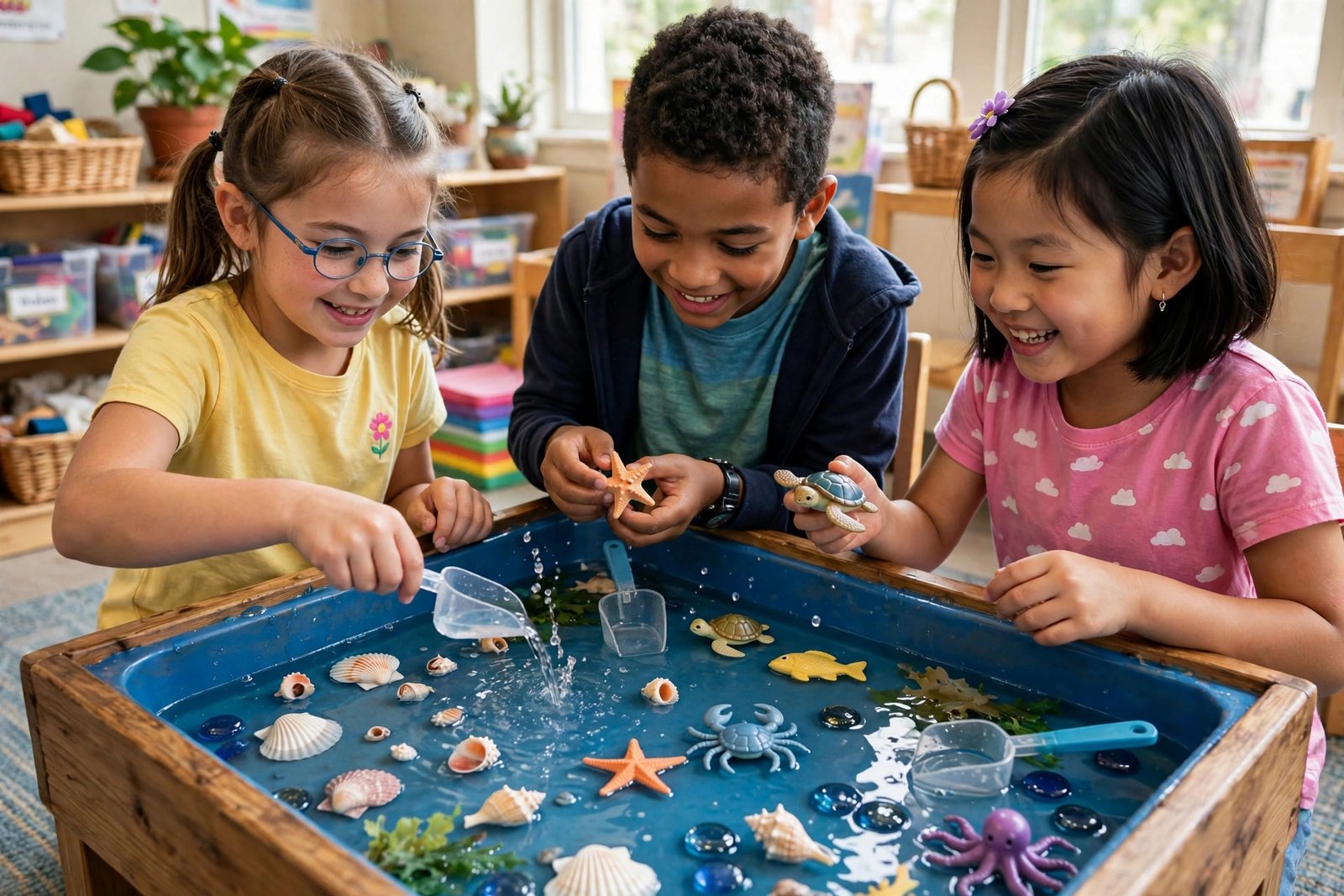
Set out a shallow tray with a little water, sand, small rocks, and shells, and let kids build a tiny tide pool. Add a few plastic sea animals, then use a cup to pour water in and out to show how the tide rises and falls. Kids can move the rocks around and see which animals stay wet when the water pulls back. A mini tide pool shows how ocean habitats change all through the day, not just when the tide is in. Keep towels nearby, and let kids draw their tide pool when they finish.
8. Ocean Layers in a Jar
Pour honey, dish soap, colored water, and cooking oil slowly into a clear jar, one layer at a time, and watch them settle into separate bands. Each layer stands for a zone of the ocean, from the deep dark water at the bottom to the sunny surface at the top. Kids can name one animal that lives in each layer. Ocean layers in a jar make deep water easy to picture because kids can see the zones stacked in front of them. Screw the lid on tight, and keep the jar on the science shelf.
9. Shell Sorting and Matching
Spread a mix of real or plastic shells on a table and let kids sort them by size, shape, color, or pattern. Then ask kids to find matching pairs, count how many of each kind there are, and draw their favorite shell with careful detail. Talk about how shells protect the soft animals that live inside them and why some shells are smooth while others are ridged. Shell sorting builds observation and math skills at the same time, and it keeps busy hands focused. Store the shells in a labeled box so the set is ready to use again.
10. How Do Whales Stay Warm
Fill one plastic bag with a thick layer of shortening to act like blubber, then slip a second bag inside it so a child can put a hand in cleanly. Fill a tub with cold water and ice, and let kids dip one bare hand in the water and then the bag covered hand. The bag hand stays warm much longer, which shows how blubber keeps whales warm. The blubber glove experiment makes insulation real because kids feel the difference firsthand. Wipe bags clean after each turn, and let kids describe the difference in one sentence.
Ocean Movement and Play Activities
Some kids learn best when they move, and the ocean gives movement a clear purpose. These games burn off energy, build coordination, and still keep the class listening for cues. Clear a little floor space first, set one clear rule about staying in bounds, and the games will run themselves.
11. Swim Like a Sea Animal
Call out a sea animal and let the class move like it across the room, such as gliding like a ray, wiggling like an eel, or bobbing like a jellyfish. Play soft music and change the animal every thirty seconds so the class keeps moving. Add a sound for each animal, like a gentle whoosh or a soft pop. Swimming like a sea animal builds imagination and coordination because kids have to think about how each creature moves. This one works well for younger grades and for days when the class needs to move before writing.
12. Ocean Freeze Game
Play lively music and let the class dance around the room. When the music stops, everyone freezes, but the freeze has to match a sea animal you call out, such as a starfish with arms out wide or a turtle tucked low to the ground. Kids who move after the music stops sit out one round and clap the beat for the dancers. The ocean freeze game builds listening and balance because kids have to stop fast and hold a pose. Change the animals each round to keep the game fresh each time.
13. Beach Ball Toss Questions
Write ocean questions on a beach ball, such as name a sea animal, name something that lives on a coral reef, or name one thing the ocean gives us. Toss the ball to a child, and that child answers the question nearest their right thumb before tossing it to someone else. Keep the questions easy so every child can answer, and let kids help write new questions on the ball. A beach ball toss keeps review light and active because the game moves the question around the room. Use a soft ball indoors, and keep the tosses gentle.
14. Crab Walk Relay
Split the class into two teams and show kids how to crab walk, on hands and feet with belly up and knees bent. Each child crab walks to a line and back, then tags the next teammate to go. The team that finishes first wins, but everyone wobbles and laughs on the way across the floor. A crab walk relay builds strength and teamwork because every child has to finish their turn for the team to win. Keep the path short and clear of desks and bags, and let kids who struggle walk it with a friend.
I tried this in my class last month, and here is what happened. I set up the crab walk relay on a Friday afternoon when the class was restless, and the first team fell apart because two kids kept forgetting to tag the next runner. I stopped the race, showed the tag step again slowly, and started over. The second run went smoothly, and the quietest girl in the class won her leg by a good margin. She grinned all the way back to her desk. The relay did not fix the whole afternoon, but it gave her a small win, and that was enough.
15. Under the Sea Scavenger Hunt
Hide paper sea animals, shells, and blue wave cards around the room, or tape them under desks and on shelves. Give each child or pair a checklist with pictures of the items to find, and set a timer for ten minutes. Kids search, check off each item they find, and bring the cards back to a basket. An under the sea scavenger hunt builds careful looking because kids have to scan the room instead of rushing past things. Count the finds together at the end, and let the class help hide the cards for the next round.
Ocean Stories Reading and Writing Activities
Ocean stories give kids words for a world they may never have seen in person. These activities mix reading, writing, and drawing, so kids build language skills while they explore the sea. Keep the reading short, the writing tasks clear, and the sharing time generous, since kids love hearing each other's ocean ideas.
16. Write a Postcard From the Deep Sea
Give each child a postcard sized piece of card and ask them to imagine they are visiting the deep sea. On the front, kids draw what they see, such as glowing fish, dark water, or a strange tall rock. On the back, they write three short lines about their trip, such as what they saw, what surprised them, and what they want to see next. A deep sea postcard builds descriptive writing because kids have to picture a place they cannot visit. Read a few postcards aloud, and pin the rest on the board for the class to enjoy.
17. Ocean Animal Fact Cards
Let each child pick one ocean animal and make a fact card with its name, a drawing, where it lives, what it eats, and one fun fact. Kids can use classroom books to find the facts, and the teacher checks each card first. The class plays a matching game with the cards, reading a fact aloud and guessing which animal it belongs to. Ocean animal fact cards build research and reading skills because kids have to find facts and write them in their own words. Keep the cards in a box so the class can play the game again.
18. Class Ocean Story Chain
Start a story on the board with one sentence about a sea adventure, then let each child add one sentence in turn. The story can wander from a lost baby turtle to a friendly whale to a storm at sea, and the twists keep it fun. Write each sentence as it is spoken so the class can see the story grow, then read the whole thing aloud. A class story chain builds listening and sequencing because each new sentence has to fit what came before it. Copy the finished story onto a poster, and let the class pick a title.
19. Sea Creature Riddle Cards
Help each child write a riddle about a sea animal, with three clues and the answer on the back of the card. Clues can cover where the animal lives, what it eats, and one special feature, such as eight arms. Kids swap cards with a partner and try to guess the animal from the clues alone. Sea creature riddles build describing and guessing skills because kids have to pick clues that are helpful but not too easy. Keep the best riddles in a class riddle book, and pull one out as a warm up on slow mornings.
20. Ocean Poem With Wave Words
Ask the class to brainstorm wave words, such as splash, drift, sparkle, deep, and blue, and list them on the board. Then each child writes a short poem using at least three wave words, about the sea or a favorite ocean animal. Kids can draw a picture next to their poem, and volunteers read theirs aloud. An ocean poem builds word choice and rhythm because kids have to pick words that sound like the sea they describe. Collect the poems into a class book, and let kids take turns reading it during quiet time.
Frequently Asked Questions
What supplies do most of these ocean activities need?
Most of these activities use things a classroom already has, such as paper, paint, glue, crayons, and plastic bottles. A few need water, salt, shells, or food coloring, and those are cheap to pick up at a grocery store. Start with the activities that use what you have on hand, and add one or two new supplies each week. The best ocean lesson is the one you can start today without a shopping trip.
How much time should ocean activities take each day?
Ten to fifteen minutes a day is enough to make a real difference, and it fits easily between lessons or right after lunch. A longer session of twenty to thirty minutes once or twice a week works well for bigger projects like the coral reef or the ocean layers jar. The key is regularity, so short and often beats long and rare. Pick one slot in your day and protect it.
What if some kids are afraid of the ocean or deep water?
Keep the focus on gentle, friendly parts of the sea, such as tide pools, starfish, and colorful fish, and skip the scary deep water talk. Let nervous kids pick art or sorting activities first, where the ocean stays on paper and in their hands. Never force a child to watch a video or listen to a story that frightens them, and praise the small steps, like touching a shell or drawing a fish. Most kids relax once they see the ocean theme is safe and fun.
Can ocean activities fit into science and reading lessons?
Yes, ocean activities fit naturally into both subjects. Science lessons can use the sink or float test, the tide pool, and the blubber glove experiment to teach real ideas about water, habitats, and animal bodies. Reading and writing lessons can use the fact cards, the story chain, and the postcards to practice research, sequencing, and descriptive words. The theme ties the subjects together, so kids meet the same ideas in more than one form.
How can teachers keep ocean art projects from making a huge mess?
Cover tables with old newspaper or plastic tablecloths before the paint comes out, and set out one small cup of water per table for brush rinsing. Give each step its own short time limit so paint and glue do not sit out all lesson, and keep a stack of paper towels within reach. End art time five minutes early so kids can wash hands and stack drying work neatly. A little prep at the start saves a lot of cleaning at the end.
What is the best age for these ocean activities?
These activities are built for elementary students, roughly ages six to eleven, and most of them work across that whole range. Younger kids do best with the art, movement, and sorting activities, where the steps are simple and the results come fast. Older kids enjoy the science experiments, the fact cards, and the writing tasks, where they can dig a little deeper. Adjust the number of steps up or down, and every activity can fit the grade in front of you.
Final Thoughts
The ocean gives a classroom a theme that never runs dry. It holds art, science, stories, and play in one place, and it gives every child something to wonder about, whether that child loves to paint, to test, to move, or to write. Start with one activity from this list, the one that feels easiest to you, and try it this week. Watch which kids light up, notice what works and what flops, and adjust the next one based on what you saw. Over time those small moments add up into a class that explores together, asks better questions, and treats learning about the sea as a normal part of the school day. That is a gift your students will carry with them long after they leave your room, and it starts with a single wave on a plain Tuesday afternoon.
