
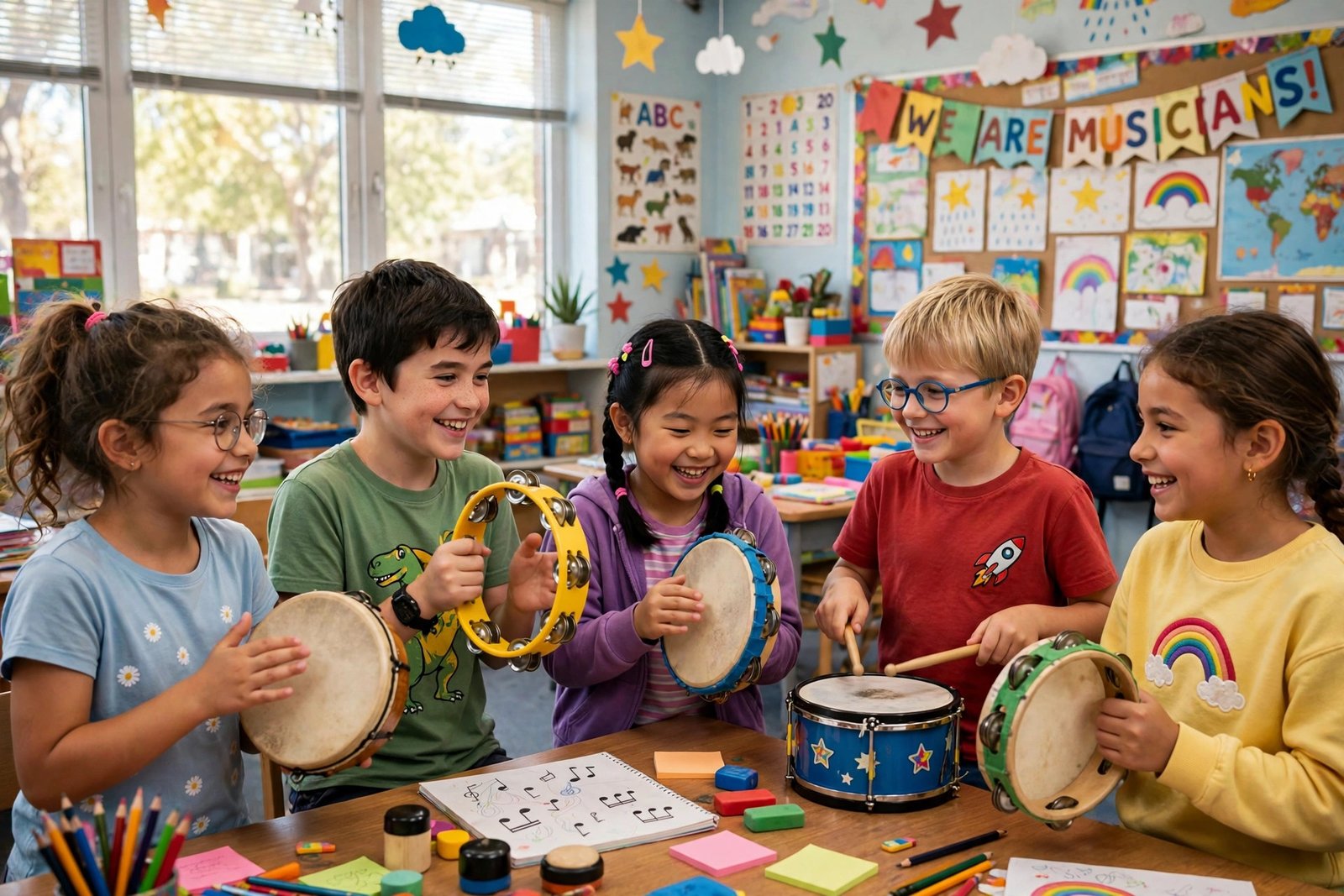

Last Tuesday my third graders walked in after lunch with that slow, sleepy energy that makes the whole room feel heavy. I clapped a short rhythm, three quick claps and one slow one, and waited. A boy in the back clapped it back without even looking up from his desk. Then a girl near the window added a stomp. Within a minute the whole class was trading rhythms back and forth, wide awake and grinning, and we had not even started the lesson yet.
Music does that in an elementary classroom. It wakes up tired minds, it pulls quiet kids into the group, and it turns a plain Tuesday afternoon into something the class remembers. You do not need a music degree or a room full of instruments to make it work. You need a few simple ideas, a little room to move, and the nerve to start singing first even when your voice wobbles a bit.
The twenty activities below are grouped so you can pick one that fits your day. Some take five minutes and need nothing at all. Others fill a whole lesson and end with something the class made together.
Table of Contents
Sing-Along Games That Get Everyone Joining In
Singing together is the fastest way to build a class that feels like a team. These games keep the focus on fun, not on perfect pitch, so even the shy kids find a way in. Start with the easy ones, keep the tempo relaxed, and let the class lead the sound once they know the pattern.
1. Echo Singing Warm Up
Stand at the front of the room and sing a short line from a song the class already knows, then pause and let the class sing it back to you. Keep each line to four or five words so little voices can hold it. After two rounds, hand the leader job to a student and let that child pick the next line. Echo singing builds listening skills because kids have to hear the tune before they can repeat it. Use it as a two minute warm up at the start of the day or right after recess when the class needs to settle.
2. Name That Tune With Humming
Hum the first few notes of a familiar song and let kids raise a hand when they think they know it. The child who guesses right gets to hum the next one. Start with songs from class, school assemblies, or tunes most kids hear at home. Humming levels the playing field because kids who feel shy about singing can still play. Play three or four rounds and stop while the energy is still high so the class wants to play again tomorrow.
3. Fill In The Missing Word
Sing a verse the class knows well, then stop just before the last word of a line and point at the group. The class shouts the missing word together, which feels like a small win every time. Pick songs with strong rhymes so the missing word is easy to guess. After a few rounds, let one student be the singer who stops, while the rest of the class fills in the gaps. Missing word singing builds memory and focus because kids have to track the words and the tune at the same time. It works well as a quick brain break between lessons.
4. Singing Telephone
Line the class up or sit them in a circle, then whisper a short song line into the ear of the first child. Each child passes the line along by singing it softly to the next person. The last child sings out loud what they heard, and the class compares it with the original. The tune almost always changes along the way, and that drift is the fun part. Singing telephone teaches careful listening because one careless pass changes the whole song. Keep the lines short, keep the mood light, and laugh with the class when the ending sounds nothing like the start.
5. Class Karaoke With Props
Pick a simple song, print the words in large type, and set out a few silly props such as a toy microphone, a scarf, or a paper crown. Small groups take turns singing one verse while wearing a prop, and the rest of the class claps along to the beat. Let kids who do not want to sing hold the words chart or play a shaker instead, so everyone has a job. Karaoke with props lowers the pressure because the silly hat gets the attention, not the singer. End with the whole class singing the chorus together so nobody sings alone at the end.
| Activity | Time Needed | What Kids Do | Skills Practiced |
|---|---|---|---|
| Echo Singing Warm Up | 2 to 5 minutes | Repeat short sung lines back to the leader | Listening and pitch matching |
| Name That Tune With Humming | 5 to 10 minutes | Guess familiar songs from a hummed melody | Memory and melody recognition |
| Body Percussion Patterns | 5 to 10 minutes | Clap, pat, and stomp in set patterns | Rhythm, coordination, and focus |
| Homemade Shaker Parade | 15 to 20 minutes | Make shakers and play them in a parade | Fine motor skills and steady beat |
| Freeze Dance With A Twist | 10 to 15 minutes | Dance and freeze in a pose when music stops | Listening, balance, and self control |
| Sound Detective | 10 minutes | Identify everyday sounds with eyes closed | Careful listening and sound words |
| Make Up A Class Song | 20 to 30 minutes | Write new words to a known tune together | Rhyming, writing, and teamwork |
Rhythm and Simple Instruments
Rhythm is the part of music that kids feel in their bodies before they understand it in their heads. These activities need little or no equipment, and they work for the whole class at once. Keep the patterns short at first, then let the kids make them harder once they feel steady.
6. Body Percussion Patterns
Teach a short pattern using claps, thigh pats, snaps, and stomps, such as clap, clap, pat, stomp. Repeat it four times while the class joins in, then change one sound and see if they can follow. Once the class feels solid, split the room into two groups and give each group a different pattern to play at the same time. Body percussion needs zero supplies and it still teaches steady beat, coordination, and working together. It is a great filler when you have five minutes before lunch and a restless class.
7. Homemade Shaker Parade
Fill small plastic bottles or cups with dried beans, rice, or small pebbles, then tape the lids shut so nothing spills. Let each child decorate a shaker with tape, stickers, or a paper label with their name. Then line up and march around the room or down the hall while shaking to a song the class knows. Homemade shakers give every child an instrument for almost no cost, and kids take better care of something they built themselves. Keep a few spare shakers ready for kids who finish late or for days when a shaker goes missing.
8. Rhythm Copycat
One child claps or taps a short rhythm, and the rest of the class copies it exactly. Then the next child takes a turn as the leader. Start with four beat patterns, then let confident kids try six or eight beats. If a pattern is too tricky, the leader can show it twice before the class copies it. Rhythm copycat builds focus fast because kids have to watch and listen at the same time. It works as a quick warm up, a line up game, or a calm down activity after a noisy lesson.
9. Drum Circle Story Time
Set out a mix of small drums, pots, boxes, or upturned buckets, one for each child or one per pair. Tell a short story and let the class play a sound for each part, such as a soft tap for walking, a loud boom for a storm, and a fast patter for running. Pause the story at key moments and let kids suggest what sound should come next. Drum circle stories link music to reading because kids match sounds to words, feelings, and events. Keep the rules simple, one drum per child and sticks stay low, so the fun does not turn into chaos.
10. Cup Rhythm Routine
Give each child a plastic cup and teach a simple routine, such as tap the cup on the desk, pass it right, clap, and pick it up again. Practice slowly first, then add a song and speed up a little at a time. When the class can do it smoothly, split into two circles and try the routine facing each other. Cup rhythms teach sequencing and teamwork because one missed pass affects the whole circle. Cups are cheap, quiet to store, and easy to replace, which makes this a favorite for teachers on a tight budget.
Movement, Dance, and Musical Games
Some kids learn best when they move, and music gives movement a purpose. These games burn off energy, build coordination, and still keep the class listening for cues. Clear a little floor space first, set one clear rule about staying in bounds, and the games will run themselves.
11. Freeze Dance With A Twist
Play a lively song and let the class dance freely around the room. When the music stops, everyone freezes, but with a twist, each freeze has to match a word you call out, such as star, tree, or statue. Kids who move after the music stops sit out one round and clap the beat for the dancers. Freeze dance with a twist builds listening and balance because kids have to stop fast and hold a pose. Change the freeze words each round to keep the game fresh and to stretch the kids a little more each time.
12. Musical Chairs With A Song Swap
Set up chairs in a circle, one fewer than the number of players, and play music while kids walk around them. When the music stops, everyone finds a seat, and the child left standing picks the next song from a short list on the board. That child then joins the circle as the song chooser for the next round, so nobody sits out for long. Song swap musical chairs keeps everyone involved because the child without a chair still picks the next song.
13. Animal Walk Dance
Call out an animal and a way to move, such as waddle like a penguin, hop like a frog, or slither like a snake, while music plays in the background. Kids move around the room in that animal style until you call out a new one. Add a sound for each animal, like a ribbit or a roar, so the room fills with music and noise together. Animal walks build imagination and gross motor skills because kids have to think about how each animal moves. This one works well for younger grades and for days when the class needs to move before sitting down to write.
14. Follow The Leader Band March
One child leads a marching line around the room while the rest follow, playing pretend instruments or shaking real ones. The leader sets the steps, such as high knees, tip toe, or a slow stomp, and changes the move every few seconds. After one lap, the leader goes to the back and the next child takes the front. A marching band line builds turn taking and steady beat because the whole line has to move together. Keep the music marching style and the path clear of desks and bags so the line can move safely.
I tried this in my class last month, and here is what happened. I started the band march with a shy boy at the front because he had asked for the drum, and for the first half lap he barely moved his feet. Then the class started chanting his name to the beat, softly and kindly, and he lifted his knees higher and started grinning. By his second turn he was leading the line with a loud stomp and a wave. The march did not fix everything in one day, but it gave that boy a moment where the whole class moved with him instead of watching him, and that mattered more than getting the steps right.
15. Scarf Dancing To The Beat
Hand each child a light scarf or a piece of ribbon and play music with a clear, steady beat. Kids wave, twirl, and float their scarves to match the music, high and fast for loud parts, low and slow for soft parts. Call out simple prompts such as make a big circle, draw a rainbow, or let it fall like rain. Scarf dancing helps kids feel musical changes because their arms show what their ears hear. Scarves are cheap, easy to store in a box, and gentle enough for small rooms where running games would not work.
Listening, Creating, and Quiet Music Time
Not every music activity has to be loud. Quiet listening and creating build a different set of skills, and they give the class a calm way to end the day. These ideas work well after lunch, during indoor recess, or as a soft landing before dismissal.
16. Sound Detective
Have the class close their eyes and sit still while you make a sound, such as shaking keys, tapping a pencil, tearing paper, or pouring water. Kids raise a hand and guess what made the sound, then describe it with one word such as sharp, soft, or buzzy. After a few rounds, let students take turns making a mystery sound for the class. Sound detective sharpens careful listening because kids have to focus on small details instead of the big noise. It also builds describing words, which helps with writing later in the day.
17. Draw What You Hear
Play a short piece of music and give each child paper and crayons. Ask them to draw what the music makes them think of, such as waves, a storm, a parade, or a quiet forest. There are no wrong answers, and kids can use colors and shapes instead of neat pictures. When the music ends, let a few kids share their drawing and say one sentence about it. Drawing to music builds imagination and personal response because each child hears the same piece in a different way. Keep the pieces short, about two minutes, so the drawing stays fresh.
18. Make Up A Class Song
Pick a tune the class knows well, such as a simple folk song or a familiar nursery tune, and write new words about your class, your school, or the season. Start with one verse together on the board, then let small groups write the next verse. Sing the whole song together at the end and clap for each group that added a verse. Writing a class song builds rhyming and teamwork because kids have to fit their words to a beat they already know. Record the class singing it if you can, and play it back so the kids hear what they made.
19. Music Mood Sorting
Play four short clips with very different moods, such as happy, calm, spooky, and excited, and ask the class to sort each clip into a mood word on the board. Let kids explain why a clip feels happy or calm, using words like fast, slow, loud, soft, or high. Then let kids vote on which mood fits the morning best and play one more clip to match it. Mood sorting builds musical vocabulary because kids learn to name what they hear instead of just feeling it. It also gives you a gentle way to talk about feelings during the school day.
20. Quiet Listening Corner
Set up a small corner with a few cushions, a pair of headphones, and a short list of calm songs or nature sounds. During free choice time, one or two kids at a time can visit the corner, listen for a few minutes, and then draw or write one line about what they heard. Keep the rule simple, quiet voices in the corner and hands to yourself. A quiet listening corner gives busy kids a reset without leaving the room or missing the class. Rotate the song list each week so the corner stays interesting all year.
Frequently Asked Questions
Do I need to be a good singer to lead music activities in my class?
No, you do not need a strong singing voice at all. Kids respond to energy and confidence far more than perfect pitch, and they will join in when they see you enjoying the song. If you feel nervous, start with rhythm games, humming, or recorded music, and let your voice grow steadier over time. The class cares that you sing with them, not that you sing perfectly.
How much time should music activities take each day?
Five to ten minutes a day is enough to make a real difference, and it fits easily between lessons or right after lunch. A longer session of twenty to thirty minutes once or twice a week works well for bigger projects like writing a class song or holding a drum circle. The key is regularity, so short and often beats long and rare. Pick one slot in your day and protect it.
What if some kids refuse to sing or dance in front of the class?
Give those kids a different job first, such as holding the words chart, playing a shaker, or keeping the beat with a clap. Many kids join in on their own once they see the activity is safe and nobody is judged. Never force a child to perform alone, and praise the small steps, like humming along or tapping a foot. With time, most reluctant kids find their own way into the music.
What simple instruments work best on a small budget?
Start with things you already have, such as pots, wooden spoons, plastic cups, and bottles filled with beans. Add a few cheap items over time, like egg shakers, tambourines, or a small xylophone, and let kids share them in turns. Homemade instruments work just as well as store bought ones for most classroom games. The best instrument is the one every child can hold and play without worry.
How do I keep music time from getting too loud or out of control?
Set one clear rule before the music starts, such as instruments stay low or voices stay inside voices, and practice it once without music. Use a simple signal, like a raised hand or a short chime, that means stop and listen right away. Keep the activities short and end each one with a calm moment, like a quiet song or a deep breath. Kids handle loud fun well when they know the stop signal works every time.
Can music activities help with reading and math skills?
Yes, music and school skills overlap more than most people expect. Rhyming songs build sound awareness that supports early reading, and counting beats builds the same steady counting used in math. Songs with sequences help kids remember steps in order, and call and response games build the listening focus that reading needs. Music does not replace reading and math lessons, but it gives kids extra practice in a form they enjoy.
Final Thoughts
Music in an elementary classroom does not need to be a big production. It needs a teacher who is willing to start, a few simple ideas that fit the day, and kids who feel safe enough to join in. Start with one activity from this list, the one that feels easiest to you, and try it this week. Watch which kids light up, notice what works and what flops, and adjust the next one based on what you saw. Over time those small moments add up into a class that sings together, listens to each other, and treats music as a normal part of learning. That is a gift your students will carry with them long after they leave your room, and it starts with a single song on a plain Tuesday afternoon.
