
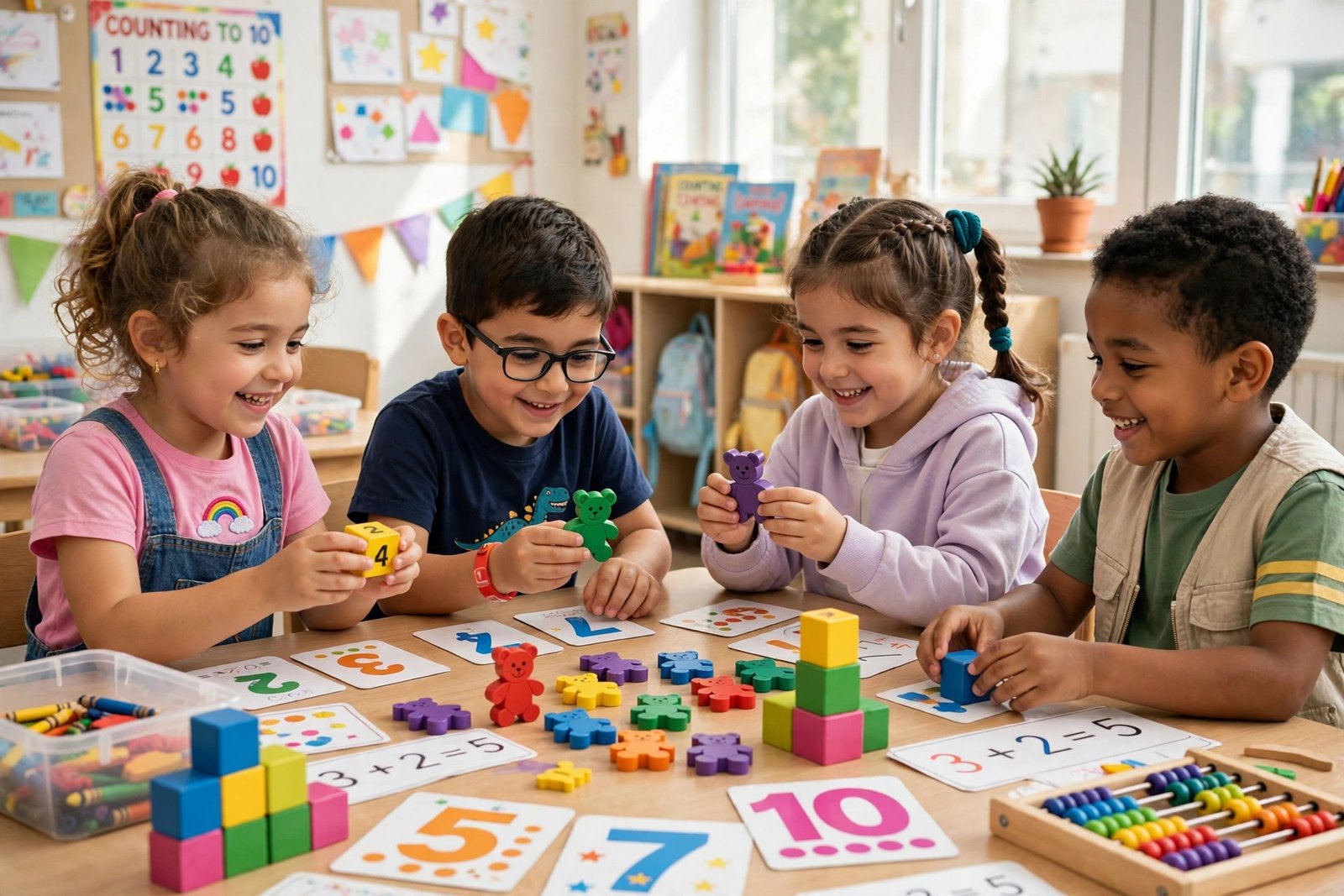

Here is what you need to turn math time into the favorite part of your day: a handful of dice, some number cards, a few cups and counters, and about ten minutes of free time. That is really it. You do not need fancy kits or expensive apps. The games below use things you probably already have in your classroom, and each one works with a small group or a full class. Pick one or two a day, rotate them through the week, and watch your students start asking for math time instead of dreading it.
Table of Contents
Counting Games That Build Number Sense
Counting games are the foundation. Before children can add or subtract, they need to feel comfortable with numbers in order, out of order, and in real groups of objects. These games make that practice feel like play.
1. Counting Cup Race
Give each child a cup and a pile of small counters, like buttons or dried beans. Roll a die, and everyone counts out that many counters into their cup as fast as they can. The first child to finish with the right number wins the round. For a calmer version, skip the race and let children check each other's cups. Counting out loud while they drop in each counter helps them connect the number word to the object. Keep the piles small at first, then move to two dice as they grow more confident.
2. Hopscotch Counting
Draw a hopscotch grid on the floor with tape or chalk, numbering the squares from one to ten. A child tosses a beanbag, hops to that square, and says the number out loud. Then they hop back, counting every square they land on. You can switch it up by asking them to hop only on even numbers or to count backward from ten. Movement plus counting is a powerful mix for young learners who struggle to sit still. It also works well as a quick brain break between lessons.
3. Mystery Number Bag
Fill a cloth bag with small objects, like crayons, blocks, or plastic animals. A child reaches in without looking, pulls out a handful, and counts how many they grabbed. Then they write or say the number. The surprise factor keeps this game fresh every time. Estimating first adds an extra layer: ask the child to guess how many they think they grabbed before counting. Even a wild guess builds number sense, because they start to learn what five feels like versus what fifteen feels like.
4. Clap and Count
The teacher claps a number of times, and the children hold up that many fingers or shout the number. Then switch roles and let a child be the clapper. This game needs zero materials and works anywhere, even in line for lunch. Listening carefully is the hidden skill here, since children must count sounds instead of objects they can see. Start with numbers under five, then work up to ten. For a challenge, clap two groups of claps and ask children to add them together.
5. Number Line Walk
Lay a long strip of paper on the floor with numbers one through twenty written on it. Call out a number, and a child walks to that spot and stands on it. Then ask them to walk two steps forward or one step back and tell you the new number. Seeing numbers in a line helps children understand that numbers have order and distance. You can also place a small toy on a number and ask children to name the number before it or after it. This game is a great warm-up before any addition lesson.
Addition and Subtraction Games
Once children can count with confidence, simple adding and taking away become the next step. These games keep the numbers small and the actions hands-on, so the math stays concrete.
6. Roll and Add Dice
Each child rolls two dice and adds the dots together. They can count the dots on both dice, or count on from the bigger number if they are ready. The child with the highest total wins the round, or children can simply record their totals on a small sheet. Counting dots one by one is perfectly fine at this stage, and it builds real understanding. Use larger foam dice if small ones are hard to handle. You can also use one die for children who are just starting out.
7. Snack Math
Give each child a small paper plate with a few crackers or cereal pieces. Ask them to eat two, then count how many are left. This is subtraction they can taste, and children love it. Real objects make subtraction real, because taking away is something they can see and feel. Keep the starting numbers under ten, and always check for allergies before using food in a lesson. If food is not an option, use counting bears or cubes instead, and the game works just as well.
8. Ten Frame Fill
Draw a ten frame on a whiteboard or give each child a printed one. Roll a die, and children place that many counters on the frame. Roll again and add more until the frame is full. Then ask how many more they need to reach ten. Ten frames build a picture of ten in children's minds, which helps them later with bigger numbers. This game also teaches the idea of "how many more," which is the start of missing-addend thinking. Laminated frames with dry erase markers work well for repeated use.
9. Bowling Subtraction
Set up six to ten plastic bottles or cups as bowling pins. A child rolls a soft ball, counts how many pins fell, and figures out how many are still standing. The starting number minus the fallen pins gives the answer. Bowling makes subtraction physical, and children do not even realize they are doing math. Keep score on the board if you want, or just play for fun. Soft balls and light pins keep the game safe indoors, and you can reset the pins quickly between turns.
10. Story Problem Puppets
Use two simple puppets or stuffed animals to act out a tiny math story. One puppet has three apples, and the other gives it two more. How many apples now? Children answer, then act out the next story themselves. Stories give numbers meaning, because children see why adding matters in real life. Keep the stories short and silly, and let children invent their own. When a child makes up a story problem, they are showing real understanding, not just repeating a memorized fact.
Comparing and Sorting Games
Comparing numbers and sorting objects are early math skills that often get overlooked. These games build them in a playful way, and they pair well with science and art activities too.
11. More or Less Showdown
Give each pair of children a set of number cards from one to ten. Both players flip a card at the same time, and the player with the bigger number keeps both cards. The player with the most cards at the end wins. Comparing numbers quickly is the skill being built here, and the card game format keeps it exciting. If both players flip the same number, they can each flip again for a tiebreaker. This game also works with dot cards instead of numerals for children who are still learning to read numbers.
12. Sorting Station Race
Set out a mixed pile of objects in different colors, sizes, or shapes. Children sort them into groups as fast as they can, then explain their sorting rule to a partner. One child might sort by color while another sorts by size, and both are right. Sorting builds logical thinking, because children must decide what makes things alike or different. Use buttons, shells, blocks, or classroom supplies you already have. After sorting, ask children to count each group and say which group has the most.
13. Which Is Bigger
Hold up two groups of objects, like four blocks and seven blocks. Ask children to point to the bigger group, then count both groups to check. After a few rounds, switch to number cards instead of objects. Estimating before counting is a useful habit, because it trains children to judge amounts at a glance. Start with groups that look clearly different in size, then make the amounts closer together as children improve. This game takes only a few minutes and fits easily into a morning meeting.
14. Pattern Block Puzzles
Give children a set of pattern blocks and a simple picture card to copy, or let them build freely. Ask them to name the shapes they used and count how many of each shape appear. Shapes and counting together give children practice in two areas at once. You can also ask children to copy a pattern, like red, blue, red, blue, and say what comes next. Pattern work is early algebra in disguise, and children enjoy it because it feels like building, not like a lesson.
Measurement and Shape Games
Measurement and shapes connect math to the real world. Children measure their shoes, compare heights, and hunt for circles in the classroom. These games make those ideas concrete.
15. Measure With Your Feet
Ask children to measure the length of a table or a rug using their own feet, heel to toe. Then compare answers: why did one child get twelve feet and another get fifteen? Measuring with body parts shows children that units matter, and that different units give different numbers. This leads naturally to a talk about rulers and standard units later. Keep the measuring playful and let children measure desks, books, and even each other's shoes. Record the results on the board and talk about what you notice.
16. Shape Hunt
Call out a shape, like triangle or rectangle, and children race to find something in the room with that shape. A clock might be a circle, a book might be a rectangle, and a slice of pretend pizza might be a triangle. Finding shapes in real life helps children see that math is everywhere, not just on worksheets. Give each child a small checklist of shapes to find, and let them draw what they discover. This game works outdoors too, where children can find shapes in playground equipment and nature.
17. Build a Shape
Give children craft sticks or straws and ask them to build a shape with a certain number of sides. Three sticks make a triangle, four make a square or rectangle. Then ask them to count the corners. Building shapes by hand teaches children the parts of a shape in a way that looking at a picture cannot. Add a twist by asking children to combine two triangles into a new shape and name what they made. Pipe cleaners work well for this game because they bend and hold their shape.
Games That Mix It All Together
Some games pull several skills into one activity. These are great for review days, math centers, or Friday fun, when you want children to use everything they have learned.
18. Math Bingo
Make simple bingo cards with numbers from one to twenty. Call out a problem, like "two plus three," and children cover the answer on their card. The first child to cover a full row wins. Hearing a problem and finding the answer mixes listening, adding, and number recognition in one game. You can adjust the difficulty by calling out plain numbers for beginners or simple problems for children who are ready. Laminated cards and small counters make this game reusable all year long.
19. Number Scavenger Hunt
Hide number cards around the room, from one to twenty. Give children a list of tasks, like "find the number that comes after seven" or "find a number bigger than twelve." Children search the room and bring back the right cards. Moving around while thinking keeps energy high and attention focused. This game works well in pairs, so children can talk through the clues together. You can also hide dot cards or simple addition problems instead of plain numbers for extra challenge.
20. Classroom Store
Set up a pretend store with small classroom items priced from one to ten cents. Give children play coins and let them buy items, counting out the right amount each time. Paying with coins mixes counting, adding, and real-life math in a way children love. One child can be the shopkeeper, which adds subtraction when they give change from ten. Keep prices low and items simple, like pencils, erasers, or stickers. Rotate the shopkeeper role so everyone gets a turn on both sides of the counter.
A Quick Comparison to Help You Choose
| Game | Main skill practiced | Best group size | Prep time |
|---|---|---|---|
| Counting Cup Race | Counting objects | Small group | Low |
| Hopscotch Counting | Number order | Whole class | Medium |
| Mystery Number Bag | Counting and estimating | Small group | Low |
| Clap and Count | Counting sounds | Whole class | None |
| Number Line Walk | Number order and position | Small group | Medium |
| Roll and Add Dice | Addition | Pairs | Low |
| Snack Math | Subtraction | Whole class | Low |
| Ten Frame Fill | Making ten | Small group | Low |
| Bowling Subtraction | Subtraction | Small group | Medium |
| Story Problem Puppets | Addition stories | Whole class | Low |
| More or Less Showdown | Comparing numbers | Pairs | Low |
| Sorting Station Race | Sorting and counting | Small group | Medium |
| Which Is Bigger | Comparing amounts | Whole class | None |
| Pattern Block Puzzles | Shapes and patterns | Small group | Low |
| Measure With Your Feet | Measurement | Whole class | None |
| Shape Hunt | Shape recognition | Whole class | Low |
| Build a Shape | Shape parts | Small group | Low |
| Math Bingo | Addition and number recognition | Whole class | Medium |
| Number Scavenger Hunt | Number order and comparing | Pairs | Medium |
| Classroom Store | Counting money | Small group | Medium |
Frequently Asked Questions
How long should each math game last?
Most of these games work best in ten to fifteen minute sessions. Young children lose focus during long activities, so short and lively beats long and slow. If a game is going well and children are still engaged, you can stretch it to twenty minutes, but watch for wandering attention. It is better to stop while they still want more than to push until they are tired of it.
Can I use these games with a large class?
Yes. Many of these games, like Clap and Count, Shape Hunt, and Math Bingo, work with a full class at once. For small group games, set up math centers and rotate groups through them during the week. That way every child gets a turn without you needing twenty sets of materials. A mix of whole class games and center games keeps the week balanced.
What if some children already know the numbers and others do not?
That spread is normal in kindergarten. Pair a stronger counter with a child who is still learning, so they can help each other. You can also adjust the difficulty inside the same game, for example by using one die for some children and two dice for others. The games stay fun for everyone when the challenge level fits the child, so do not be afraid to tweak the rules.
Do I need to buy special materials for these games?
No. Almost everything here uses dice, cups, counters, cards, or items already in your room. Buttons, dried beans, blocks, and craft sticks all work as counters. If you want to invest in one thing, a set of large foam dice and a bag of counting bears will cover most of these games. Keep materials in labeled bins so setup takes minutes, not half your planning period.
How do I know if the games are actually helping children learn?
Watch what children do during the games. A child who once counted every dot one by one and now counts on from the bigger number is making progress. Listen for the language they use, like "more," "less," "bigger," and "how many more." Quick checks, like asking a child to count a small group during the game, tell you more than a worksheet does, and they take seconds.
A Small Story From My Classroom
I tried the Classroom Store game in my class last month, and here is what happened. I priced pencils at three cents and erasers at five cents, and I gave each child ten play coins. Most children counted carefully and bought one item at a time, but one boy spent all ten coins on two erasers and then looked sad when he could not afford a pencil. Instead of fixing it for him, I asked the class what he could do, and another child suggested trading. They worked out a swap on their own, and the whole class cheered. That one unplanned moment taught more about value and trade than any lesson I had planned that week.
Final Thoughts
Math games work because they let children practice without pressure. When a child rolls a die, counts out loud, or buys a pretend pencil, they are building skills they will use for years, and they are having fun at the same time. Start with the games that need the least setup, add new ones as your children grow more confident, and do not worry about doing all twenty in one week. The best math classroom is one where children ask to play again tomorrow. So pick a game, gather a few simple materials, and enjoy watching your students fall in love with numbers.
