
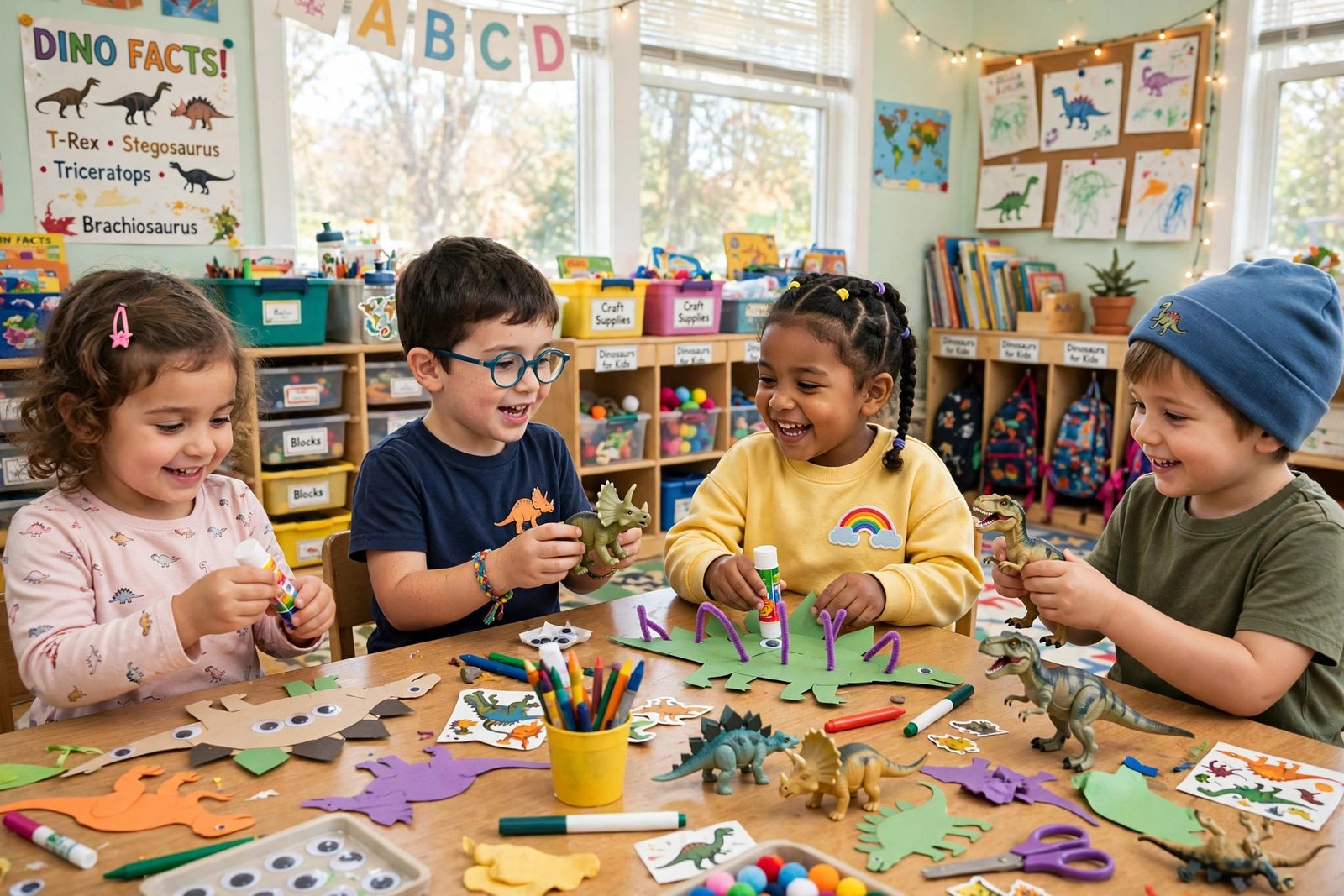

Last Tuesday, right after snack time, a little boy in my class walked up to me holding a plastic triceratops in one hand and a cracker in the other. He held the dinosaur up to his face, looked me straight in the eye, and said that his triceratops was hungry and only liked crackers shaped like leaves. The whole table burst out laughing, and within two minutes every child was feeding pretend leaves to their own dinosaur. That is the magic of dinosaurs in a preschool room. You do not need a fancy kit or a big budget, just a few simple materials and a little room for pretend play, and the children will carry the rest with their own ideas.
Dinosaurs work so well with three, four, and five year olds because they sit right at the edge of what is real and what is pretend. Children know these animals lived long ago, and that small fact makes them feel like young scientists. At the same time, dinosaurs roar, stomp, and munch leaves, so they are perfect for loud, joyful play. The activities in this post cover sensory bins, art, counting, letters, movement, and outdoor games, and you can use them as a full dinosaur week or pull out one or two on a rainy afternoon.
Table of Contents
Quick Comparison Table
Use this table to pick the right activity for your day. If you have ten minutes before lunch, choose a low mess activity, and if you have a full morning and a mop nearby, go for the fizzy eggs or the ice rescue. Most of these ideas use things already in your classroom cupboard.
| Activity | Best Age | Mess Level | What You Need |
|---|---|---|---|
| Dino Dig Sensory Bin | 3 to 5 | Medium | Bin, sand, toy dinosaurs, scoops |
| Fizzy Dinosaur Eggs | 4 to 5 | Medium | Baking soda, vinegar, small toys |
| Paper Plate Stegosaurus | 3 to 5 | Low | Paper plates, paint, triangles |
| Dinosaur Footprint Painting | 3 to 4 | High | Paint, paper, toy dinosaur feet |
| Count the Dinosaur Eggs | 4 to 5 | Low | Egg shapes, number cards, basket |
| Letter Hunt in the Dino Nest | 4 to 5 | Low | Letter cards, shredded paper, nest |
| Dinosaur Egg Hunt | 3 to 5 | Low | Plastic eggs, small toys, baskets |
Dinosaur Sensory Play
Sensory play is often the best place to start a dinosaur theme because it lets children explore with their hands first. They dig, pour, splash, and squish, and while they play they build the words they need for later learning. Words like dig, bury, hatch, stomp, and roar come out on their own when the materials invite them. Set these bins and trays out during free play and let children come and go, and you will hear richer talk at a sensory table than at almost any other spot in the room.
1. Dino Dig Sensory Bin
Fill a shallow bin with dry sand or kinetic sand and hide ten small plastic dinosaurs inside it. Add scoops, cups, and small paintbrushes so children can dig and brush the sand away like real fossil hunters. Hide the dinosaurs at different depths so some are easy to find and some take real digging. Ask children to name each dinosaur they find. When the bin gets dull, swap the sand for dry rice and hide them again.
2. Fizzy Dinosaur Eggs
Mix baking soda with a little water and press the mix around a small toy dinosaur to form an egg shape. Let the eggs dry overnight on a tray. At play time, give each child an egg, a cup of vinegar, and a dropper. Pour the vinegar slowly and watch the egg fizz as the dinosaur hatches out. Children love the fizz and the surprise of which dinosaur appears, so keep towels close by and do this on a tray so the fizz stays in one place.
3. Dinosaur Swamp Water Play
Fill a shallow tub with warm water, add a few drops of green food coloring, and drop in plastic plants, smooth stones, and toy dinosaurs. Add cups, funnels, and sponges so children can pour and squeeze. Let the dinosaurs wade and swim while children tell stories about what their dinosaur is doing in the swamp. This is a calm, cooling activity for a hot afternoon that suits children who need a quieter spot. Change the water when it gets murky.
4. Playdough Dinosaur Footprints
Roll out a thick slab of playdough on a tray and hand children a few toy dinosaurs with different sized feet. Show them how to press a foot down gently and lift it straight up for a clear print. Compare the footprints side by side and talk about which dinosaur made the biggest print and which made the smallest. Add sticks, leaves, and small stones so children can build a tiny scene around the prints, then roll the dough flat again when the prints get crowded and start over.
5. Dinosaur Ice Rescue
Freeze small toy dinosaurs in cups of water the night before, one dinosaur per cup. At play time, tip each ice block into a tray and give children warm water in squeeze bottles, spoons, and salt shakers. Work together to melt the ice and free the dinosaurs, talking about which tool works fastest. Children will test the salt, the warm water, and their own hands, and argue happily about which way is best. This one takes time, so start it early.
Dinosaur Art and Crafts
Dinosaur art works best when children get to make choices and get their hands messy. You do not need perfect models or neat results. A stegosaurus with five spikes on one side and two on the other is still a stegosaurus, and the child who made it will tell you all about it. Keep the steps simple, show one finished example, and then step back, because the talk that happens while children paint and glue is where much of the learning lives.
6. Paper Plate Stegosaurus
Give each child a paper plate, cut in half, and a set of triangle shapes cut from card. Let children paint the plate green or brown, then glue the triangles along the curved edge for the plates on its back. Add four short legs and a long tail from strips of card and draw a friendly eye near the front. Some children will count their triangles as they glue, and some will make a pattern with two colors. Let the plates dry on a rack and hang them at child height for families to see.
7. Dinosaur Footprint Painting
Pour washable paint into shallow trays and put a big sheet of paper on the floor or on a low table. Dip the feet of a large toy dinosaur in the paint and walk it across the paper to leave a trail of footprints. Change colors for each dinosaur so children can follow one trail and see where it crosses another. This is messy in the best way, so use smocks and cover the floor with old newspaper. Children love seeing a trail appear behind the dinosaur, and they will ask to try a different dinosaur right away.
8. Toilet Roll Dinosaur Puppets
Save empty toilet rolls and let children turn them into dinosaurs with paint and glue. Paint the roll green, then add a head and tail cut from card, plus paper spikes or spots. Stick on wobbly eyes and a paper mouth with triangle teeth, and the puppet is ready for a show. Children can hold the roll and make their dinosaur roar, stomp, and talk to a friend's dinosaur, and a small puppet stage made from a box lets pairs act out a short scene together.
9. Dinosaur Egg Craft with Tissue Paper
Cut a large egg shape from white card and give each child small squares of colored tissue paper and a glue stick. Show children how to scrunch each square into a tiny ball and glue it onto the egg shape. Fill the egg with bright colors and leave a small flap that opens to show a baby dinosaur drawn inside. This is a calm, focused craft that suits a quiet afternoon, and the scrunching builds finger strength. When the eggs are dry, tape them to the window.
10. Sponge Painted T Rex
Cut a sponge into a rough dinosaur shape or use a plain kitchen sponge for stamping. Pour green and brown paint into trays and let children stamp the sponge onto paper to build a T Rex shape. Stamp the body first, then add legs and a tail with smaller sponge prints, and finish with a paper eye and a row of teeth. Children love the soft thump of the sponge and the way the prints overlap, and this works well as a group mural too, with each child adding one dinosaur to a long roll of paper.
A Quick Story From My Classroom
I tried this in my class last month, and here is what happened. I set out the paint and one big brontosaurus, and the children took turns walking it across the paper. The first trail was perfect, but the second child pressed too hard and the dinosaur slipped, leaving a big green smear across the whole page. For a second I thought the painting was ruined, but the children decided the smear was a swamp and painted lily pads around it. The painting stayed on the wall for two weeks, and the children called it the swamp picture. Now I tape the paper down at the corners before we start, and the swamp stays where it belongs.
Dinosaur Learning Games
Children learn letters, numbers, and sorting best when the learning is hidden inside play. A dinosaur game does not feel like a lesson, so children stay longer and try harder. Keep the rules short, play alongside the children for the first round, and then let them take over. If a game is too easy, add a twist, like a timer or a second set of cards, and if it is too hard, take cards away and play with fewer pieces.
11. Dinosaur Matching Game
Make pairs of cards with matching dinosaur pictures and lay them face down in rows. Children take turns flipping two cards and keeping the pair when they match. Say the dinosaur name out loud each time you flip a card, so children hear the names again and again. Start with six pairs for younger children and add more as they get confident. This game builds memory and new words at the same time, and it packs away in a zip bag.
12. Count the Dinosaur Eggs
Cut egg shapes from card and write a number from one to ten on each egg. Put a basket of small toy dinosaurs nearby. Children pick an egg, read the number, and place that many dinosaurs next to it. Count out loud together and touch each dinosaur as you count so children link the number to the amount. For children who are ready for more, ask them to find the egg that comes after or before their number, and swap the eggs each day so children do not just memorize the order.
13. Letter Hunt in the Dino Nest
Fill a shallow tray with shredded paper to make a nest, and hide letter cards inside it. Call out a letter sound and let children dig through the nest to find that letter. Hold the letter up and say its sound before putting it on a display strip, and let the child who found it choose the next letter to hunt for. Use the letters in the children's names first, because those are the letters they care about most, and this is a gentle way to practice letter sounds without a worksheet in sight.
14. Dinosaur Sorting by Size
Gather toy dinosaurs in small, medium, and large sizes, and put out three trays marked with matching footprints. Children sort each dinosaur into the tray that matches its size. Talk about big, bigger, and biggest as you sort, and line them up from smallest to largest when you finish. For a challenge, sort by color or by leg count, and talk about how the groups change. Sorting builds early math thinking, and children love arguing about which tray a tricky dinosaur belongs in.
15. Roar and Freeze Listening Game
Play music and let children stomp around the room like dinosaurs. When the music stops, call out a dinosaur name and children freeze in a pose for that dinosaur. Freeze like a tall brontosaurus with your neck stretched up, or crouch low like a baby dinosaur hiding in the grass. This game builds listening skills and body control, and it burns off energy on a rainy day, so keep the rounds short and let a child be the music stopper when they are ready.
Dinosaur Movement and Outdoor Play
Dinosaurs are big, loud, and full of movement, so they belong outside as much as they belong at a table. Outdoor dinosaur play lets children run, stomp, jump, and shout in ways that a classroom does not always allow, so use the playground, the garden, or a patch of grass, and keep the rules simple. The best outdoor games need almost no equipment, just space and a few children who are ready to roar.
16. Dinosaur Stomp Dance
Put on a lively song and teach a simple stomp pattern, like stomp, stomp, clap, roar. Practice the pattern slowly, then speed it up a little each round. Stomp in a circle together and let one child at a time step into the middle to show their own dinosaur move. Some children will spin, some will flap their arms, and some will do a slow heavy stomp that makes everyone laugh, and this is a lovely whole group activity for the start or end of the day.
17. Dinosaur Egg Hunt
Hide plastic eggs around the garden or classroom, with a small toy dinosaur or a picture of a dinosaur inside each one. Give each child a basket and a simple rule, like find three eggs and bring them back to the nest. Count the eggs together when everyone returns, and let children open their eggs one at a time to show the group what they found. Hide the eggs at different heights so some are easy to spot and some need a real search, and play it again the next day with the eggs in new hiding places.
18. Build a Dinosaur Habitat
Take the class outside with a basket of loose parts, like sticks, leaves, stones, pinecones, and cardboard boxes. Let small groups build a home for their toy dinosaurs, with a nest, a pond, and a food spot. Talk about what a dinosaur needs to live, like water, food, and a safe place to sleep, while children build, then walk around together when the habitats are done and let each group explain what they built. This is open ended play at its best, and no two habitats ever look the same.
19. Dinosaur Obstacle Course
Set up a simple course with cones to weave around, a low bench to crawl under, and a hoop to jump through. Give each part a dinosaur name, like the triceratops tunnel, the volcano jump, and the swamp stepping stones. Stomp through the course like a dinosaur and roar each time you pass a cone. Time the course only if children ask for it, because most preschoolers care more about the stomping than the clock, and change one part of the course each day so it stays fresh.
20. Story Stones and Dinosaur Tales
Paint simple pictures on smooth stones, like a dinosaur, a volcano, an egg, a tree, and a sun. Put the stones in a bag and let each child pull out three stones. Tell a short story using all three pictures and let the group add a sentence each to keep the story going. One child might start with a baby dinosaur hatching, and the next might add a volcano rumbling in the distance. This builds language, turn taking, and imagination, and it works just as well indoors on a rug as outside under a tree.
Frequently Asked Questions
How do I introduce dinosaurs to preschoolers who know nothing about them
Start with a picture book or a toy dinosaur and ask children what they notice, like the big teeth, the long tail, or the plates on the back. Keep the first talk short and let children ask questions, and start with three or four friendly types, adding more over the week as children get curious.
What age is best for dinosaur activities
Most dinosaur activities work well for children aged three to five, and you can adjust each one to fit your group. Younger children love sensory play, painting, and movement games, while older preschoolers enjoy counting, letter hunts, and matching games. If an activity feels too hard, use fewer pieces, and if it feels too easy, add one small challenge.
How do I keep dinosaur play from getting too wild
Set one clear rule before you start, like we stomp our feet but we keep our hands gentle, and model it yourself. Give loud play a clear time and place, like outside or during a music game, and then move to a calmer activity. Children roar because dinosaurs roar, so a little wildness is part of the fun.
What materials do I need for a dinosaur theme week
You need a set of small plastic dinosaurs, a bin for sensory play, paint, paper, glue, and a few cardboard boxes. Most of these activities use things you already have, and you can swap materials freely if something is missing. A few toy dinosaurs go a long way, because children will use the same ones all week long.
How can I link dinosaur activities to early learning goals
Dinosaur play links to counting when children count eggs, to letters when they hunt for sounds in the nest, and to science when they talk about hatching, digging, and habitats. Sorting dinosaurs builds early math thinking, and story stones build language and imagination, and you can note these links in your planning without turning the play into a lesson.
How do I handle children who find dinosaurs scary
Some children do find big teeth and loud roars a little scary, and that is normal, so start those children with baby dinosaurs, eggs, and gentle stories, and let them watch first before they join in. Never force a child to touch a scary toy or join a loud game. Most children join in on their own once they see their friends having fun.
Can I use these dinosaur activities outdoors
Yes, many of these activities work even better outside, especially the egg hunt, the obstacle course, the habitat building, and the stomp dance, because outdoor play gives children space to be loud and to move in big ways. Just take water, sun hats, and a first aid kit, and check the play area before the children arrive.
Final Thoughts
Dinosaurs give preschool teachers a rare gift, a topic that children already love before you even start. You do not need to be an expert or to buy a shelf of new toys, just a few dinosaurs, a few simple materials, and the patience to let children lead the play. Start with one activity from this post, watch how your class responds, and build from there. Some days the sensory bin will be the hit, and some days the stomp dance will be the one they ask for again.
Keep the dinosaur toys out for the whole week if you can, because children will return to them in ways you cannot plan. A dinosaur from the counting game will show up in the story stones, and one from the art table will end up in the habitat outside. That is how deep play works. Save this post, pick your favorites, and let your class roar, dig, paint, and stomp their way through a dinosaur week they will remember.
