
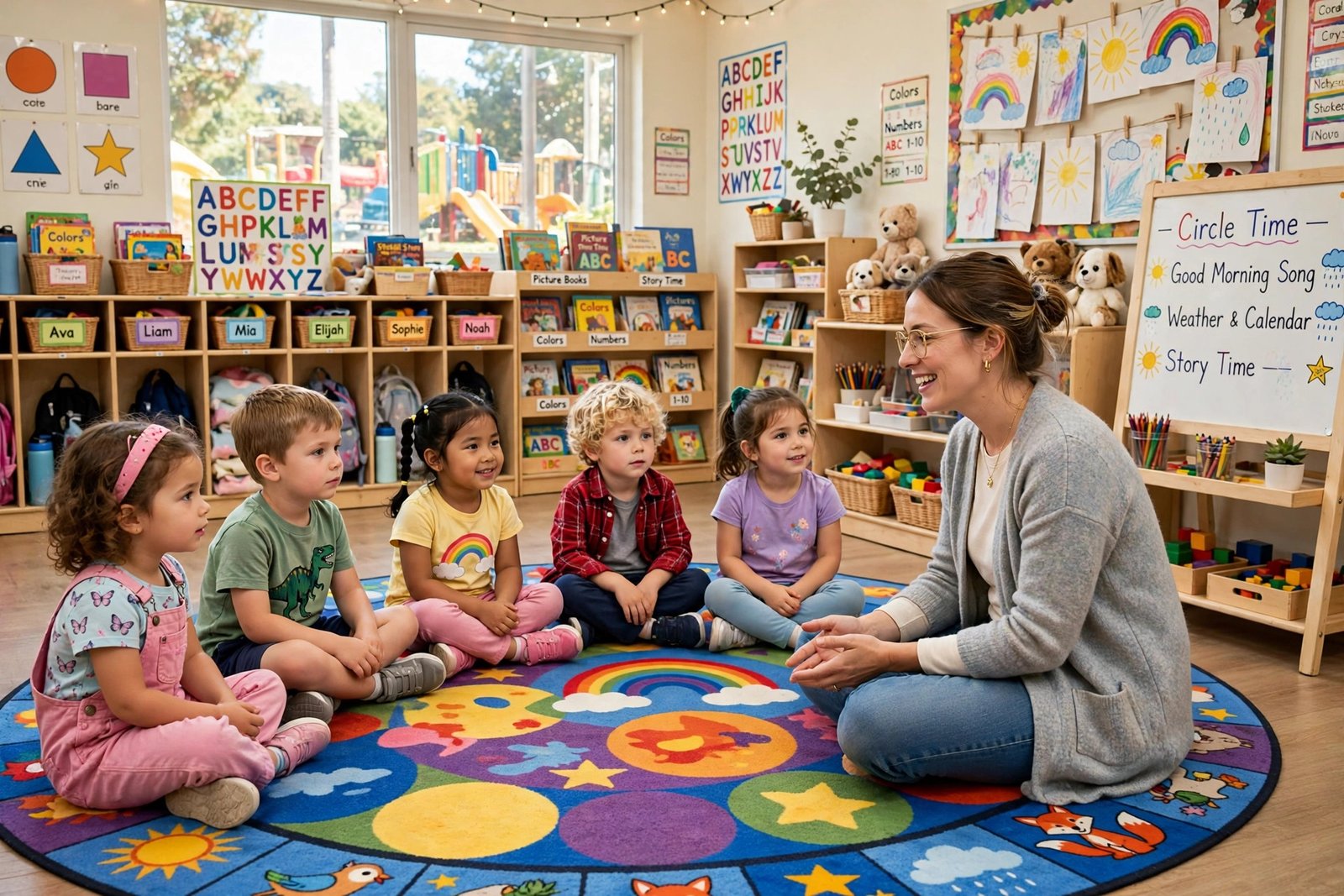

How do you keep twenty preschoolers sitting, listening, and smiling for fifteen minutes without losing half the group to wiggles and whispers? If you have ever watched your circle slowly fall apart while you were still on the first song, you are not alone. Circle time is one of the hardest parts of the preschool day because young children learn with their whole bodies, and sitting still is not their natural state. The good news is that circle time does not have to feel like a battle. When the activities are short, playful, and full of chances to talk, move, and guess, children want to stay. This list gives you twenty simple ideas you can mix and match across the week. Each one is easy to set up, easy to explain, and easy to change for a small group or a full class. Use them to build routines children look forward to, and watch your circle become the favorite part of the morning.
Table of Contents
Warm Up the Circle
A warm welcome helps children settle and feel safe. Keep this part short and predictable. Use the same opening song or greeting for a week or two, then swap in a new one when children know it well. The goal is connection first, learning second. When children feel seen by name and heard about their feelings, they are far more ready to listen to what comes next.
1. Good Morning Hello Song with Names
Sing a simple hello song and pause to sing each child's name. Point to the child, smile, and let the group wave or clap for that friend. You need no materials, just a tune you can repeat every day. Keep the pace steady so shy children do not feel rushed. Say each name clearly and let children answer with a wave, a hello, or a silly sound if they wish. If your group is large, split names across two days so the song stays short and joyful.
2. Feelings Check In with Picture Cards
Show four large cards for happy, sad, tired, and excited. Pass the cards around and ask each child to point to the one that matches how they feel today. You can use printed faces, drawn faces, or photos of puppets. Give children a short sentence starter such as "Today I feel" and let them finish it or just point. Honor every answer without fixing it or asking why in front of the group. This builds emotional words and helps you spot who might need extra comfort.
3. Weather Watchers
Put a simple weather board in the middle of the circle with sun, cloud, rain, and wind pictures. Ask one child to look out the window and pick the picture that matches today. Then ask the group what clothes fit that weather. You need only the board and a pointer or a magnet. Keep questions short and concrete. Connect weather to real life by asking what they will wear at recess or whether they need a jacket. Change the helper daily so everyone gets a turn.
4. Counting Friends on Fingers
Count how many children are present by pointing around the circle together. Start at one and let the group count aloud with you. Then count how many are away, using empty chairs or name cards left in a basket. You need name cards or a simple attendance chart. Use fingers, claps, or taps on knees to keep counting active. Count slowly and together so children who are still learning numbers can join in without stress. Celebrate when the group reaches the final number.
5. Mystery Box Guess
Place one familiar object inside a box or bag that children cannot see through. Shake it gently, let one child feel it without looking, and ask the group to guess what it is. Use safe classroom items such as a block, a spoon, a crayon, or a small ball. Give two or three clues if the group gets stuck. Let children describe what they feel with words like soft, hard, round, or bumpy. This builds vocabulary and curiosity, and it works well as a quick surprise to start the day.
Build Language and Listening Skills
Once children are settled, circle time is a perfect moment for talking and listening games. Keep your language simple and your turns short. Give every child a way to join, even if they prefer to point, nod, or whisper an answer to a neighbor. These activities build the listening habits children need for stories, directions, and later reading. Rotate them so no single game gets boring, and repeat favorites when children ask for them again.
6. Rhyme Time Basket
Fill a basket with pairs of small objects or pictures that rhyme, such as cat and hat, or sun and bun. Pull out one item, say its name clearly, and ask the group to find its rhyming partner. Let children say both words together and clap on the rhyme. You need picture cards or toy objects, plus a basket. If a pair is tricky, say the words slowly and stress the ending sound. Play with sounds first before you worry about letters, because hearing rhymes is the skill that matters most here.
7. Story Chain
Start a very short story with one sentence, such as "One morning, a little duck found a red umbrella." Then point to the next child to add one sentence. Go around part of the circle, not the whole group, so the story stays lively. You need no materials, just a clear start and a friendly rule that every idea counts. If a child gets stuck, offer two choices to pick from. Keep each turn to one sentence so the story moves fast and silly ideas stay welcome. End with a fun final line together.
8. Sound Hunt Listening Game
Ask children to close their eyes and listen for a sound you make, such as tapping a block, shaking a shaker, or clapping twice. Then ask what they heard and where the sound came from. You need a few simple sound makers hidden behind your back or in a bag. Start with one clear sound, then try two sounds in a row for older preschoolers. Ask children to listen first, then talk so they practice waiting and paying attention. Praise careful listening, not just fast answers.
9. Who Am I Animal Clues
Give three simple clues about an animal, one at a time, and let children guess after each clue. For example, say it has four legs, it says moo, and it lives on a farm. Use animal pictures or puppets to show the answer at the end. You need picture cards or a small puppet. Keep clues concrete and visual, not tricky. Pause after each clue so children have time to think and whisper guesses to a neighbor. Let the child who guesses correctly hold the picture for the next round.
10. Letter Treasure in the Circle
Hide large foam letters or letter cards under a cloth in the middle of the circle. Pull out one letter, name it, and ask children to think of a word that starts with that sound. You can also ask them to find something in the room that starts with the same sound. You need foam letters or cards and a cloth. Focus on sounds children know, and repeat the sound together. Celebrate every sensible word even if it is not perfect, because confidence grows when trying feels safe.
Compare Activities at a Glance
Use this table when you need a fast pick for the day. Some activities calm the group, some wake it up, and some work best with a small group. Pick a low energy activity after recess or lunch, and save a high energy game for a morning when children arrive full of wiggles. You can also pair one quiet activity with one active activity so the circle has a nice rise and fall. Keep the total circle time short, and stop while children are still enjoying it.
| Activity | Group Size | Time Needed | Energy Level |
|---|---|---|---|
| Good Morning Hello Song with Names | Whole class | 5 minutes | Low |
| Feelings Check In with Picture Cards | Whole class | 5 minutes | Low |
| Mystery Box Guess | Small to whole class | 5 minutes | Medium |
| Rhyme Time Basket | Small to whole class | 7 minutes | Medium |
| Story Chain | Small group | 8 minutes | Medium |
| Sound Hunt Listening Game | Whole class | 5 minutes | Low |
| Freeze Dance with Shapes | Whole class | 7 minutes | High |
| Action Counting Jump | Whole class | 5 minutes | High |
| Quiet Breathing with Stuffed Friends | Whole class | 4 minutes | Low |
| Kind Words Circle | Small to whole class | 6 minutes | Low |
Move, Wiggle, and Learn
Movement is not a break from learning in preschool. It is how many children learn best. These games let children stand, jump, stretch, and dance while still practicing counting, listening, and following directions. Keep the space safe and the rules simple. Show the movement once yourself, then let the group copy you. If energy gets too high, switch to a slower movement or a breathing game before you continue.
I tried this in my class last month, and here is what happened. I picked freeze dance for a Friday morning when the children were extra bouncy, and I made the music far too fast. Two children bumped into each other, one fell over laughing, and the whole circle turned into a pile of giggles. I stopped the music, slowed the song right down, and gave everyone a spot on a carpet square to dance in. The second try worked beautifully, and now we always use spots and a slower song first.
11. Freeze Dance with Shapes
Play music and ask children to dance in place or in a small space. When the music stops, hold up a shape card and ask everyone to freeze like that shape. Use a circle, square, triangle, and star to start. You need music and large shape cards. Keep dancing bursts short, about twenty seconds, so children do not get too wild. Freeze fast and hold still for three seconds, then dance again. This builds listening, body control, and shape names all at once.
12. Action Counting Jump
Pick a number, such as five, and ask children to jump that many times while the group counts aloud. Change the action to claps, stomps, or arm waves. You need no materials, just a clear number and a steady count. Start with small numbers and build up as children get confident. Count together out loud so children hear the number words in order while they move. If a child loses count, smile and start again together without making it a test.
13. Follow the Leader Moves
Stand in the middle and do a simple movement, such as touching your head, hopping once, or waving both arms. Ask the group to copy you, then let one child become the leader for the next move. You need no materials and very little space. Keep each move to one clear action so younger children can follow it. Copy the leader exactly and praise children who watch carefully before they move. Rotate leaders quickly so many children get a turn in one short game.
14. Simon Says Body Parts
Play a gentle version of Simon Says using body parts only. Say "Simon says touch your nose" and let children copy you. Sometimes say a body part without Simon says, and see if children can wait and giggle instead of moving. You need no materials, just clear words and a playful tone. Keep the pace slow for younger groups. Listen for the words Simon says before you move, and remind children that waiting is part of the game. End with a silly move everyone can do.
15. Pass the Rhythm Beat
Start a simple rhythm by clapping twice and patting your knees once. Pass the rhythm around the circle by pointing to the next child to copy it. Then change the rhythm to stomps, snaps, or quiet taps. You need no materials, just a steady beat you can keep yourself. Start slow and repeat the same pattern three times before you change it. Keep the beat steady and simple so every child can join, even if their claps are a little off beat. Celebrate the group sound at the end.
Calm Down and Connect
A calm ending helps children leave circle time feeling settled and ready for the next part of the day. These activities slow the pace, give children a voice, and build kindness. Use a soft voice yourself, dim the energy with slow movements, and keep turns short. Even two minutes of calm connection can change the mood of the whole morning. End with the same closing song or goodbye phrase each day so children know what comes next.
16. Quiet Breathing with Stuffed Friends
Give each child a small stuffed animal or ask them to pretend they hold one. Ask them to place it on their belly and watch it rise and fall as they breathe in slowly and breathe out slowly. You need stuffed animals or a simple pretend prompt. Do three slow breaths together, counting in a soft voice. Breathe in through your nose and out through your mouth in a slow and gentle way. If a child giggles, let it pass and invite them to try the next breath with you.
17. Kind Words Circle
Pass a soft ball or a talking stick around the circle. The child holding it can say one kind word about a friend, or say one thing they like about the class. Model short examples first, such as "I like how Sam shares blocks." You need a soft ball or a special object to pass. Keep answers to one short sentence and let children pass if they prefer not to talk. Use kind and specific words so children learn what helpful praise sounds like. Thank each child for their kind word.
18. Show and Tell in Two Sentences
Invite two or three children to share one small item or one short story in just two sentences. Give a simple frame such as "This is my" and "I like it because." You need a small basket for items brought from home or from the classroom shelf. Set a timer or use a song cue to keep turns short. Keep it to two sentences so the group stays focused and more children get turns across the week. Ask one follow up question from the group, then move on warmly.
19. Thankful Moments Sharing
Ask children to think of one good moment from today or yesterday. It can be as small as a yummy snack, a fun block tower, or a hug from a friend. Go around part of the circle and let each child share in one short sentence. You need no materials, just a calm prompt and time to listen. Model your own thankful moment first so children understand the size of idea you mean. Name one small good moment and let the group give a quiet thumbs up or a smile. This builds gratitude without making it heavy or formal.
20. Goodbye Song and Tomorrow Teaser
End circle time with the same short goodbye song every day. After the song, give one tiny teaser for tomorrow, such as "Tomorrow we will paint with sponges" or "Tomorrow we will meet a new puppet." You need no materials, just a song children know and one exciting hint. Keep the teaser short so children leave curious, not restless. End on the same song and the same smile so children learn that circle time has a clear and happy finish. Wave goodbye together as a group.
Frequently Asked Questions
How long should preschool circle time last?
For most preschool groups, ten to fifteen minutes works well. Younger threes may do best with eight to ten minutes, while older fours and fives can often enjoy up to twenty minutes if the activities change often. Watch the group, not the clock, and end while children are still engaged. A short and happy circle beats a long and restless one every time.
What do I do if children will not sit still?
Let movement be part of the plan instead of fighting it. Add action songs, jumping counts, and standing games between quiet activities. Give wiggly children a job, such as holding a card or pointing to the weather board. If the whole group is restless, it often means the circle has gone too long or the activity is too hard, so switch to something active and try again later.
How many activities should I plan for one circle?
Plan two or three activities for one circle, plus your hello and goodbye routines. A warm up, one learning game, and one movement or calm activity is plenty for most days. Planning too many activities can rush the group and leave no time for children to talk. Keep one backup idea ready, but do not feel you must use every idea every day.
What if one child never wants to join circle time?
Give that child a nearby choice, such as sitting on a cushion just outside the circle or holding a quiet fidget toy. Invite them gently without forcing them, and praise any small step toward joining. Sometimes a special job, like being the weather helper, makes the circle feel safer. Talk with families if the pattern lasts, since tiredness, language, or worries can all play a part.
How do I handle a very large class at circle time?
Split the group when you can, or use activities where everyone can answer together by clapping, pointing, or calling out a word. Use name sticks or a helper chart so turns feel fair, and keep each turn very short. Large groups do best with clear visuals, strong routines, and lots of group responses instead of long one by one turns.
Should circle time be the same every day?
Keep the opening and closing the same, but change the middle activities often. Children love the comfort of a familiar hello song and goodbye song, and they also love new games and surprises. A good rhythm is one familiar routine, one favorite game repeated across the week, and one new activity to try. This mix builds security and curiosity at the same time.
Final Thoughts
Circle time works best when it feels like time together, not time spent waiting for instructions. Pick activities that let children talk, move, guess, and laugh, and keep each one short enough to leave them wanting more. You do not need fancy materials or perfect behavior to make it work. You need a warm welcome, a clear routine, and a few playful ideas you can pull out on a busy morning. Try one new activity this week, notice what your group loves, and build from there. With time, your circle will become a place where children feel known, heard, and ready to learn.
