
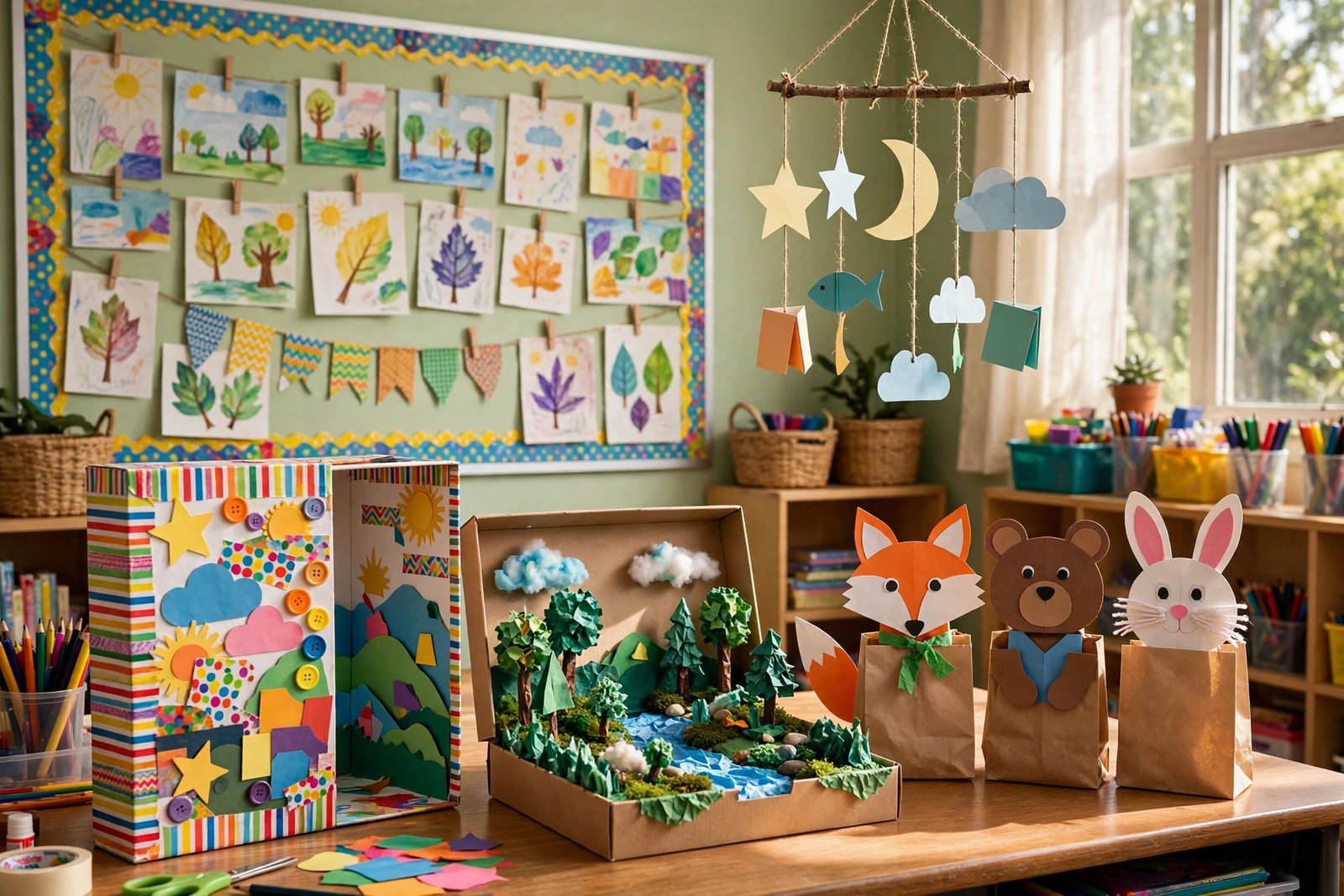

Creative book report ideas give elementary students fresh ways to show what they read beyond the standard written summary. A book report idea for elementary students can be a diorama, a puppet show, a recipe card, or a mock interview, and each one asks kids to retell a story, describe characters, and share an opinion in a format that feels like play instead of work.
These creative book reports work especially well for young readers who freeze up at blank pages. When a teacher lets kids pick a project that matches their strengths, reading comprehension becomes something students look forward to. The twenty ideas below are built for real classrooms, with simple materials, clear steps, and grading that stays fair across every grade level.
Table of Contents
- Why Creative Book Reports Work
- Compare Book Report Idea Types
- Creative Book Reports Kids Can Make
- Book Report Ideas for Active Learners
- Book Reports That Turn Writing Into Fun
- STEM and Craft Book Report Projects
- Take-Home and Family-Friendly Book Report Ideas
- Final Thoughts
- Frequently Asked Questions
Why Creative Book Reports Work
Traditional book reports ask a young reader to sit down and summarize a whole story in paragraph form, and many elementary students find that task dull before they write the first sentence. Creative book report ideas keep the reading goal but change the delivery method. A student who struggles with paragraphs might shine when building a scene from a shoebox, acting out a chapter with puppets, or interviewing a character. Teachers report that reluctant readers read more carefully when they know an engaging project waits at the end of the book.
These projects also fit the way elementary classrooms actually run. Many of the ideas below use materials teachers already keep on hand, such as construction paper, index cards, glue sticks, and crayons. Most can be finished in one or two class periods, and several work as take-home projects that involve families without asking parents to buy supplies. That balance matters, because a creative book report should feel exciting for students and manageable for the teacher.
Choice sits at the heart of all twenty ideas. Letting students pick from a menu of book report projects gives them ownership of the work, and ownership leads to stronger effort. A kid who loves drawing will pour energy into a comic strip, while a chatty student will light up during a reader's theater performance. The result is the same skill, reading comprehension, practiced through twenty different doors.
Compare Book Report Idea Types
| Idea Type | Prep Time | Materials | Best-Fit Grades | Assessment Value |
|---|---|---|---|---|
| Art and craft projects | 1 to 2 class periods | Construction paper, crayons, shoeboxes, index cards | K to 5 | Plot sequence, character traits, setting details |
| Performance-based reports | 30 to 60 minutes | Puppets, printed scripts, simple props | 1 to 5 | Oral retelling, dialogue understanding, confidence |
| Writing-with-a-twist reports | 1 class period | Lined paper, printed templates, pencils | 2 to 5 | Written comprehension, point of view, vocabulary |
| STEM and hands-on projects | 1 to 2 class periods | Cardboard, string, rulers, basic craft supplies | 3 to 5 | Cause and effect, sequencing, nonfiction facts |
| Take-home family projects | Weekend or week | Household items, recyclables, drawing supplies | K to 5 | Summarizing, opinion, family reading habits |
Creative Book Reports Kids Can Make
1. Diorama in a Shoebox
The shoebox diorama turns a favorite scene into a tiny three-dimensional world. Students pick one important scene, glue a background inside the box, and add small figures made from paper, clay, or recycled bits. They finish by writing a short card that explains what is happening in the scene and why it matters to the story. Teachers get a quick look at setting recall and scene selection, two comprehension skills that hide inside the fun of building. Tip, cap the box size at one shoebox so projects stay desk-friendly and easy to display.
2. Character Trading Cards
Trading cards shrink a character study down to index-card size. On the front, students draw the character and write the name in bold letters. On the back, they list character traits, a favorite quote or action, and a "stats" section with invented ratings for traits like bravery or kindness, each tied to something the character actually did. Kids who love collecting games take to this format fast, and the finished cards make a fun classroom display. This project works with any fiction book, from early readers to chapter books like the Magic Tree House series.
3. New Book Jacket Design
Ask students to imagine the publisher hired them to redesign the cover. They draw a brand-new front cover with an original illustration and a catchy tagline of their own words, then write a fresh back-cover blurb that summarizes the book without giving away the ending. The key rule is that the art and words must be original, not copied from the real cover. This idea teaches main idea and summary skills because a good blurb has to hook a reader in just a few sentences. Bonus points go to students who include a fake barcode and price for extra realism.
4. Story Quilt Squares
Each student decorates one paper quilt square showing a key moment from the book, then the class tapes all the squares together into a giant paper quilt. The square must show a beginning, middle, or end moment, which teachers can label in order along the display. This project shines as a whole-class book report after everyone reads the same title, since the quilt becomes a visual retelling of the full plot. Tip, use uniform square sizes, such as six-inch squares, so the quilt assembles cleanly and looks polished on the hallway wall.
Book Report Ideas for Active Learners
5. Puppet Show Retelling
Students retell the story with puppets made from socks, paper bags, or popsicle sticks. Working in pairs, they pick three scenes, write short dialogue for each character puppet, and perform the show for the class or record it. The prep work forces kids to identify main events and turn narration into spoken words, which deepens comprehension. Teachers can grade with a simple checklist covering story order, character voice, and teamwork. This project is a natural fit for fairy tales and folk tales, where big personalities make puppet voices easy to imagine.
6. Reader's Theater Scene
Reader's theater needs no costumes and no memorizing, which makes it the easiest performance option for shy students. The teacher or students adapt one chapter or scene into a script with a narrator and speaking parts, then kids read it aloud with expression from their seats or standing at the front. Because nobody memorizes lines, students can focus on fluency and expression instead of stage fright. Tip, assign roles by reading level so every student gets a part that stretches them just enough. Short scenes from funny books work best for a first attempt.
7. Character Charades
Each student writes the name of a character, and sometimes a key action, on slips of paper and drops them in a bowl. Players draw a slip and act out the character while classmates guess who it is and name the book. After the guess, the actor must state one character trait with proof from the story, which keeps the game anchored in real comprehension. This makes a lively review activity after a class novel or a fun center rotation during reading block. It also rewards careful readers, since only students who truly know the character can act convincingly.
8. Freeze-Frame Tableau
Groups of three to five students pose in silence as a frozen scene from the book while one narrator reads a short caption describing the moment. The rest of the class studies the tableau, then guesses which scene it shows before the group reveals the answer. This idea sharpens visualization, the habit of picturing scenes while reading, and it works with almost zero supplies. Teachers love it because setup takes minutes and every group presents in under two. For grading, ask each group to submit the written caption, which proves they understood the scene they posed.
Book Reports That Turn Writing Into Fun
9. Letter to the Author
Students write a friendly letter to the author of their book with three parts, a favorite part, a question about the story, and a suggestion for what could happen next. This format lowers the pressure of formal writing because letters feel personal and conversational. Teachers can assess opinion writing and question quality in one pass, since strong questions show deep thinking about plot or character choices. Tip, keep a class address book of publisher websites so letters can actually be mailed, because nothing motivates careful writing like a real audience. Many authors reply, which becomes its own classroom event.
10. Story Newspaper Front Page
Kids become editors and build a newspaper front page for the world of their book. The page needs a headline article about the main event, a weather report for the setting, a classified ad written by one character, and an advice column answering another character's problem. Each section demands summarizing and point of view practice disguised as journalism. This project fills a full class period and produces a display that other classes stop to read. Provide a simple template so students spend their energy on writing, not on figuring out the layout.
11. Character Diary Entry
Students write three diary entries as the main character, one from the beginning of the book, one from the middle, and one from the end. Each entry must include a feeling the character had and an event that caused it. This format teaches character perspective better than almost any worksheet, because kids must think and write as someone else. Teachers should remind students to use details from the book rather than inventing new adventures. The three-entry structure also gives a built-in check on plot sequence, since entries must land in the right order.
12. Interview a Character
One student plays a talk-show host and interviews a classmate who answers as a character from the book. The host prepares five questions in advance, and the character must answer in the character's voice using facts from the story. This idea practices questioning skills for the interviewer and text evidence for the character, since good answers need proof from the book. It works as a partner project with almost no materials beyond question cards. Tip, require at least two "why" questions, because those push students past simple recall into real thinking about motives.
STEM and Craft Book Report Projects
13. Story World Map
Students draw a detailed map of the book's world, labeling every important location and tracing the main character's journey with a colored path. Nonfiction readers can map real places from a biography or animal habitat book instead. A strong map includes a key, a compass rose, and short labels explaining what happened at each stop. This project blends geography skills with reading comprehension and suits visual learners who think in pictures. Teachers can check accuracy fast by comparing locations against the book's events. Tip, large chart paper works better than small sheets for maps with many stops.
14. Plot Timeline String
A length of string, some clothespins, and index cards turn plot sequence into a hands-on timeline. Students write one major event on each card, clip the cards to the string in story order, and add small drawings for visual cues. The physical act of ordering cards makes sequence concrete, especially for younger students who struggle with "first, next, last" language on paper. This project adapts to any length of book, from picture books with five events to chapter books with ten. Tip, have students lay the cards on the floor in order first, then clip them, which cuts down on reordering frustration.
15. Nonfiction Experiment Demo
After reading a nonfiction book about science, animals, or how things work, students design a tiny experiment or demonstration that shows one fact from the book in action. A book about plants might lead to sprouting seeds in a cup, while a weather book could inspire a simple water cycle in a bag. Students present the demo and explain the key fact it proves, connecting reading to real observation. Teachers should approve the experiment plan first for safety and supply reasons. This idea turns nonfiction reading into something kids remember long after the book is closed.
16. Story Recipe Card
For books that feature food, celebrations, or a character's favorite meal, students create an illustrated recipe card for a dish connected to the story. The card needs the recipe name, a simple ingredient list, kid-safe steps, and a note explaining the recipe's link to the book. This project practices procedural writing and careful detail, and it works beautifully with cultural stories where food carries meaning. Teachers can keep it classroom-safe by using no-cook recipes only. Tip, collect the cards into a class cookbook, which becomes a keepsake families actually want to read.
Take-Home and Family-Friendly Book Report Ideas
17. Book Trailer Storyboard
Students plan a movie trailer for their book by drawing a six-panel storyboard, with each panel showing a key moment and a line of narration or dialogue underneath. The panels must tease the story without revealing the ending, which teaches selective summarizing. This project feels modern and creative while using nothing more than paper and pencils. Teachers can let tech-savvy families film the trailer at home as an optional bonus, but the storyboard alone earns full credit so nobody needs a device. Tip, show a real movie trailer first so students understand the teasing tone.
18. Museum in a Box
Each student curates a tiny museum exhibit inside a box, filling it with five objects that represent important parts of the book. Objects can be drawn, built from clay, or borrowed from around the house. Every object gets a small museum label explaining what it is and why it matters to the story. This project rewards symbolic thinking, because students must connect a concrete object to an abstract story idea. Parents enjoy helping hunt for objects, which makes it a natural family project. Tip, set a firm object limit so boxes stay focused instead of turning into toy collections.
19. Book Tasting Menu
Students design a restaurant menu where each course represents part of the book, such as an appetizer for the opening, a main course for the climax, and dessert for the resolution. Each menu item needs a creative name and a one-sentence description linking the "dish" to the story. This playful format practices story structure in a way that feels nothing like schoolwork. It works as a take-home project or a quick in-class activity with a printed template. Teachers can pair it with an actual snack day for extra excitement, with allergy-safe treats only.
20. Book Report Board Game
Students invent a board game based on their book, with a hand-drawn path, question cards about the plot and characters, and simple rules. Players advance by answering questions correctly, which means the game designer must truly understand the story to write good cards. This is the most ambitious project on the list, so it fits best as a week-long take-home assignment or a challenge option for advanced readers. When finished, students can play each other's games during a class game day. Tip, require at least ten question cards so the game tests real comprehension instead of luck.
Final Thoughts
Creative book report ideas do their best work when teachers treat them as real assessments, not just fun extras. A clear rubric with a few rows for comprehension, effort, and presentation keeps grading fair across very different projects. Sharing the rubric before students start helps kids aim their creativity at the reading skills that matter most, and it keeps parent helpers on the right track too.
Variety across the school year matters just as much as the projects themselves. If students build dioramas in September, try the newspaper front page or reader's theater by November so the novelty stays fresh. Rotating through the five idea types also gives every learner a chance to shine in their own way. Teachers who keep a simple log of which projects each class has done find it easy to plan a balanced year of creative book reports.
Start small and build from there. Pick two or three ideas from this list that match your students' ages and your available supplies, and add a simple choice menu to your next reading unit. Watch which projects spark the most effort, then keep those in rotation and swap the rest. With twenty options on hand, no elementary class ever has to face the same tired book report twice.
Frequently Asked Questions
How do I grade creative book reports fairly?
Use one simple rubric for every project type, with rows for comprehension, effort, and presentation. Comprehension should carry the most weight, since the point is proving the student understood the book. A shared rubric keeps grading consistent whether a student built a diorama or wrote a letter, and showing it to students in advance removes most arguments about fairness.
What if parents do all the work on take-home projects?
Set clear expectations in the assignment note that the student must be able to explain every part of the project. A quick two-minute chat with the student about their choices reveals who did the real thinking. Many teachers also keep the writing portions, like labels and cards, strictly student-made, which guarantees an authentic sample of the child's own work.
Do creative book reports take too much class time?
Most of these ideas fit into one or two class periods, and several need no class time at all as homework. Teachers who worry about the schedule can reserve performance projects for Friday afternoons or reading block rotations. The time pays off because engaged students read more carefully, which strengthens the comprehension skills the projects are meant to assess.
How do I keep struggling readers from falling behind?
Let struggling readers choose shorter books at their level and pick projects that play to their strengths. Performance and art projects often suit these students better than writing-heavy ones. Pairing a struggling reader with a supportive partner for projects like reader's theater also builds confidence, and teachers can scale the rubric so effort and growth count alongside accuracy.
Can I use these ideas for nonfiction books?
Yes, and several ideas fit nonfiction especially well. The experiment demo, story world map, and timeline all work with science, history, and biography titles. For the other projects, simply swap story elements for facts, so a trading card profiles a real person or animal instead of a fictional character. Nonfiction book reports often produce the most surprising and memorable student work.
How do I stop students from picking the easiest project every time?
Require students to try a different idea type each quarter, using the five categories as a simple rotation system. A choice menu that lists only three or four options per round also keeps variety high without overwhelming kids. Many teachers find that students who start with the "easy" option soon get curious about the ambitious projects once they see classmates presenting them.
