
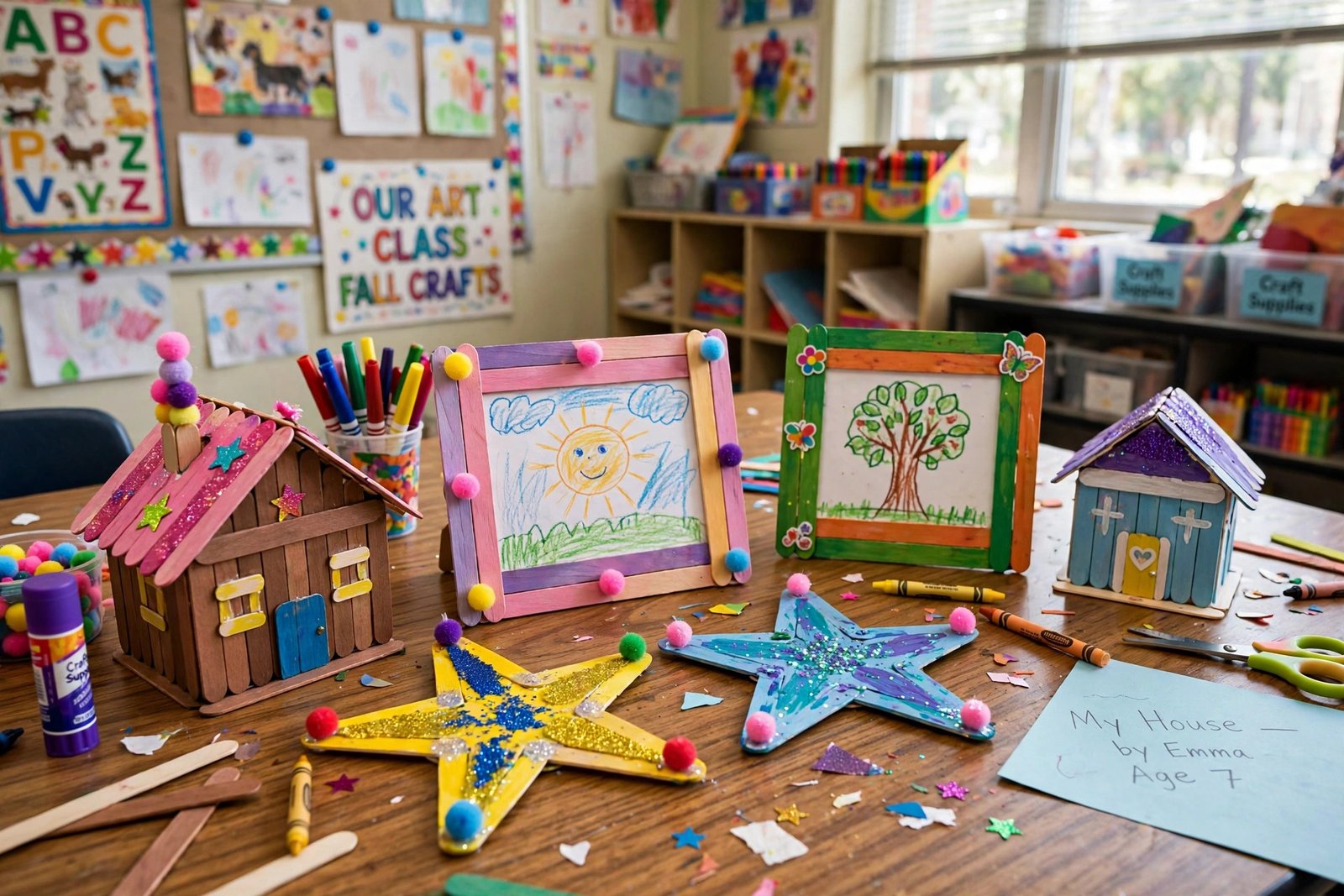

What do you do with a bag of plain wooden sticks, a class full of wiggly kids, and about forty minutes before lunch? If you are like most elementary teachers, you want something cheap, simple, and fun enough to hold their attention without turning your room into a disaster zone. That is exactly where popsicle sticks shine. They cost almost nothing, they are easy to store, and they can turn into almost anything a child can dream up.
Popsicle stick crafts work so well in elementary classrooms because they meet kids where they are. Younger students can glue and decorate with very little help. Older students can plan, measure, build, and test. Every child ends up with something real to take home, and you end up with a calm, busy room full of proud faces. The fifteen ideas below cover art, building, music, and learning games, so you can pick the ones that fit your grade level, your schedule, and your tolerance for mess.
Table of Contents
Quick Pick Table
| Craft | Best Ages | Time Needed | Mess Level |
|---|---|---|---|
| Mini Catapults | Ages 8 to 11 | 30 to 45 minutes | Low |
| Stick Airplanes | Ages 6 to 10 | 20 to 30 minutes | Low |
| Mini Log Cabins | Ages 7 to 11 | 40 to 60 minutes | Medium |
| Bridge Challenge | Ages 8 to 11 | 45 to 60 minutes | Low |
| Stick Harmonicas | Ages 6 to 9 | 15 to 25 minutes | Low |
| Picture Frames | Ages 5 to 8 | 20 to 30 minutes | Medium |
| Star Wands | Ages 5 to 8 | 20 to 30 minutes | Medium |
| Woven Coasters | Ages 7 to 10 | 30 to 40 minutes | Low |
| Bookmark Buddies | Ages 5 to 9 | 15 to 25 minutes | Low |
| Seasonal Ornaments | Ages 6 to 10 | 25 to 35 minutes | Medium |
| Story Starter Sticks | Ages 6 to 10 | 20 to 30 minutes | Low |
| Number Match Puzzles | Ages 5 to 7 | 20 to 30 minutes | Low |
| Garden Markers | Ages 6 to 10 | 25 to 35 minutes | Medium |
| Stick Puppets | Ages 5 to 9 | 30 to 40 minutes | Medium |
| Desk Name Plates | Ages 5 to 8 | 20 to 30 minutes | Low |
Before You Start
A little prep goes a long way with this kind of project. Buy the plain, natural wood sticks in bulk, and keep a second bag of colored sticks for days when you want to skip the painting step. White school glue works fine for most crafts, but a low temperature glue gun, handled by you, holds heavier builds together much faster. If your students are gluing, give each table a small paper plate of glue and a few cotton swabs for spreading it, which cuts down on puddles and sticky fingers.
Set out the extras in small cups so kids are not wandering the room mid project. Buttons, googly eyes, yarn, markers, and scrap paper cover almost every craft on this list. Old newspapers or a plastic tablecloth under each work area make cleanup take about two minutes. One more tip that saves headaches: count sticks before you hand them out, and tell each student how many they get. It keeps the building fair and stops one eager builder from taking half the bag.
Crafts That Build and Move
1. Mini Catapults
Every class has a few kids who light up the second you say the word catapult, and this one earns that excitement. Students stack about eight sticks and wrap a rubber band around each end to make a solid base. Then they attach one stick on top as the launching arm, held down with another rubber band and a bottle cap glued on as the cup. A small pom pom makes a perfect soft projectile. Kids test how far it flies, move the rubber band, and try again. Hands-on physics shows up naturally here, because students quickly learn that where they place the band changes the launch. Keep a clear launching zone and a rule that pom poms only fly at targets, never at classmates.
2. Stick Airplanes
This craft turns a handful of sticks into a little plane kids love to race down the hallway. Students glue two sticks into a long body, then add a shorter stick across the front and another across the back for wings. A small clothespin or a folded piece of cardboard makes a simple tail. Once the glue dries, they paint or color their planes and add a pilot dot or stripes. The best part comes after building, when the class tests whose plane glides farthest. Simple design choices matter here, and kids discover fast that wing position changes how far a plane travels. It is a great fit for a science unit on flight or forces.
3. Mini Log Cabins
A log cabin is the classic popsicle stick project, and it still wins with kids year after year. Students lay sticks side by side to make four walls, gluing them in a log pattern with small gaps or overlaps at the corners. A folded piece of brown construction paper becomes the roof, and a small rectangle cut from the wall makes a door. Some kids add windows, a chimney made from a short stick, or a tiny fence out front. This one takes patience, so it suits a longer art block or a two day project. Planning and patience are the real skills here, because a cabin only stands up when the walls are even and the glue has time to set.
4. Bridge Challenge
Turn building into a friendly contest and watch your students think like real engineers. Each student or pair gets the same number of sticks, usually fifteen to twenty, and a set time to build a bridge across a gap between two stacks of books. The bridge must hold a small weight, like a cup of pennies or a toy car. Kids try flat designs, triangle patterns, and layered beams, then test and rebuild. Problem solving under limits is what makes this one special, because every team faces the same materials and the same gap but lands on a different solution. Talk through the results together and let students explain why their design held or fell.
5. Stick Harmonicas
If you have never heard twenty harmonicas at once, prepare yourself, because this one gets loud in the best way. Students sandwich two sticks with a strip of paper between them, wrap rubber bands around both ends, and slide a toothpick under each band near the ends. Blowing through the middle makes a buzzing sound, and sliding the toothpicks changes the pitch. Kids decorate the outside with markers and stickers before they play. Sound exploration is the point, so let them experiment with tight and loose bands and compare the notes. This is a perfect rainy day music activity, and it pairs nicely with a lesson on how instruments make sound.
Art and Decoration Crafts
6. Picture Frames
A handmade frame turns any drawing into a gift, which is why this craft is a favorite before holidays and parent nights. Students glue four sticks into a square or rectangle, then layer a second row on top for a thicker border. They decorate with buttons, sequins, yarn wrapped around the edges, or paint in bright patterns. A photo or a small drawing gets taped to the back, and a loop of yarn on top makes it hangable. Personalized gifts mean a lot to families, and kids take real pride in choosing colors and decorations for the person who will receive it. Keep the drying area flat so frames do not warp while the glue sets.
7. Star Wands
Star wands are pure magic for younger students, and they double as props for plays and story retelling. Students glue five sticks into a star shape, which takes a little guidance but is very doable with a printed template underneath as a guide. They paint the star gold or silver, add glitter glue once the paint dries, and attach a longer stick as the handle with a ribbon tied at the join. Some kids add a jingle bell or a yarn tassel for extra flair. Following a pattern is the quiet skill built here, since the star only looks right when the angles line up. These wands also make wonderful reading corner props for fairy tale week.
8. Woven Coasters
Coasters look impressive, but the weaving pattern is simple enough for second and third graders to master. Students lay six sticks side by side, then weave six more sticks over and under them, alternating the pattern row by row. A dot of glue at each crossing holds the weave together. Once dry, they paint the coaster or stain it with markers for a wood look. Fine motor practice is baked into this craft, because weaving takes steady fingers and attention to the over under rhythm. Kids love that the result is actually useful, and a set of four makes a lovely gift for a parent or grandparent.
9. Bookmark Buddies
If you want to nudge your students toward reading, give them a reason to open a book. Bookmark buddies start with one wide stick or two regular sticks glued together. Kids decorate the top with a face, using googly eyes, yarn hair, paper ears, or a tiny paper hat. A strip of felt or ribbon glued near the top makes a tail or scarf. The bottom stays plain so it slides into a book without damage. Reading motivation gets a real boost from something this small, because kids want to use the buddy they made. Let each student pick a character, an animal, or even a mini version of themselves.
10. Seasonal Ornaments
Ornaments work for any season, not just winter, which makes this craft useful all year. For a snowflake, students glue sticks into a starburst and add white paint and glitter. For autumn, they paint sticks orange and red and arrange them into a small pumpkin shape with a green stem. For spring, a flower made from sticks radiating out of a paper center looks bright on a window. Seasonal creativity keeps this one fresh, because you can change the theme and the colors without changing the basic skills. Hang finished ornaments on a classroom tree, a branch in a jar, or a string across the room.
Learning Games and Classroom Tools
11. Story Starter Sticks
This is the craft that keeps giving long after art time ends. Students decorate a set of ten to twelve sticks with colors and small drawings, then the teacher writes one story word on each stick, like dragon, castle, storm, or lost key. The sticks go into a cup, and during writing time a student pulls three and builds a story around those words. Kids can also write their own words on blank sticks for a second set. Creative writing support is the real payoff, because a random draw pushes kids past the same old story ideas. Keep a cup of starter sticks at your writing center and watch reluctant writers get started faster.
12. Number Match Puzzles
Younger students learn number sense faster when they can hold it in their hands, and these puzzles do exactly that. Students lay five sticks side by side and tape them lightly on the back to hold them in place. Then they draw a big number, a shape, or a simple picture across the sticks. Once the drawing is done, they peel off the tape, mix the sticks up, and put the picture back together in order. Writing the numbers one through five on the back turns it into a self checking puzzle. Early math practice hides inside a fun activity here, since kids count and order without feeling like they are doing a worksheet. Make several sets for your math center.
13. Garden Markers
If your school has a garden bed, a courtyard planter, or even a few pots on the windowsill, garden markers connect crafts to real growing. Students paint sticks in bright colors and write a plant name on each one with a permanent marker, then decorate around the word with small drawings of leaves or flowers. A coat of clear tape over the writing helps it survive watering. Push the markers into the soil next to each plant, and suddenly your class garden looks cared for and labeled. Real world labeling gives kids a reason to write neatly, because the marker has a job to do outside. This also pairs well with a plant life cycle unit.
14. Stick Puppets
Puppets turn a quiet class into a storytelling stage, and they are simple enough for kindergarteners with a little help. Students glue a paper shape, like an animal face, a person, or a monster, onto the top of a stick, then add googly eyes, yarn hair, and paper details. A second stick glued across the back makes arms that kids can wiggle. Once every student has a puppet, the class can act out a story you just read, retell a fairy tale, or practice dialogue in pairs. Speaking and listening skills grow naturally during puppet play, because even shy kids will talk through a puppet when they will not speak up directly. Store puppets in a labeled cup for easy reuse.
15. Desk Name Plates
A name plate made by its owner does more than label a desk, it makes a child feel like the space is theirs. Students glue three sticks together into a small standing sign, either flat on the desk or folded into a tent shape with a glued brace on the back. They write their name in big letters, add a border pattern, and decorate with stickers or small drawings of things they like. A strip of tape along the bottom keeps the tent standing. Classroom ownership is the quiet benefit of this craft, and it is a wonderful first week activity when students are still learning names. Replace them midyear if they get worn, and let kids redesign them.
A Quick Story From My Classroom
I tried the bridge challenge in my class last month, and here is what happened. I gave each pair twenty sticks and told them their bridge had to span the gap between two book stacks and hold a small toy car. One pair built a beautiful flat bridge that looked perfect, and it collapsed the second the car rolled on. They were so disappointed that I almost stepped in, but instead I asked them what they could change. They added triangle supports underneath, tested it again, and it held. The cheer that went up was louder than anything else that day. That pair still talks about their bridge, and I learned to let the first try fail, because the rebuild is where the real learning happens.
Frequently Asked Questions
How many popsicle sticks should I buy for a class project?
A bulk bag of one thousand sticks usually covers a class of twenty five students for two or three projects, since most crafts on this list use ten to twenty sticks per child. If you plan a bigger build like the log cabin, budget about thirty sticks per student. Buying plain sticks and letting kids paint them is cheaper than buying colored ones, but colored sticks save time on days when your schedule is tight.
What kind of glue works best for popsicle stick crafts?
White school glue works for most flat crafts like frames, bookmarks, and ornaments, but it needs drying time, so plan for it. A low temperature glue gun, handled only by the teacher, is better for cabins, bridges, and anything that must stand up or hold weight. Tacky craft glue sits in the middle, since it grabs faster than school glue but is still safe for kids to use with supervision.
Are popsicle stick crafts safe for kindergarten students?
Yes, with a few simple precautions. Use jumbo sticks for the youngest kids, since they are easier to grip and harder to snap. Skip the glue gun for student use and let them use school glue or glue dots instead. Check sticks for splinters before you hand them out, and keep small decorations like beads and sequins at a table with adult help so nothing ends up in a mouth or on the floor.
How do I keep the mess under control during craft time?
Cover tables with newspaper or a plastic cloth, and put supplies in cups or trays instead of open piles. Give each table a small plate of glue and cotton swabs for spreading, which stops the giant glue puddles. Set a clear cleanup signal, like a song or a timer, and assign jobs so one table wipes, one sorts sticks, and one puts supplies away. With a routine in place, cleanup takes about five minutes.
Can I tie these crafts to my lesson plans?
Absolutely, and that is one of the best reasons to use them. Catapults and bridges fit science units on forces and structures. Story starter sticks and puppets support writing and speaking lessons. Number match puzzles work in math centers, and garden markers go with any plant unit. Pick the craft that matches what you are already teaching, and the art time doubles as review time.
How long should I allow for a popsicle stick project?
Most of these crafts fit into a thirty to forty minute block, including cleanup, if the materials are set out in advance. Bigger builds like log cabins and bridges need forty five to sixty minutes, or they can be split across two days with the first day for building and the second for decorating and testing. Always add ten extra minutes the first time you try a new craft, because kids need time to learn the steps.
Final Thoughts
Popsicle sticks will never be the fanciest supply in your classroom, and that is exactly why they work. They are cheap, they are simple, and they leave room for kids to think, build, and fix their own mistakes. Whether your students launch a catapult, weave a coaster, or pull a story starter stick from a cup, they are practicing skills that matter far beyond art time.
Start with one craft that fits your week, set out the supplies ahead of time, and let your students surprise you. Some of the best classroom moments come from the simplest materials, and a bag of wooden sticks is proof of that. Pick a project, gather your class, and build something worth keeping.
